medico: Phindile, Nompilo, and Esperande, you founded Phephisa. How did that come about?
Phindile: In South Africa, a woman is murdered by her partner or ex-partner every six hours. And that's really just the tip of the iceberg. A lot of cases don't even get recorded. We see this extreme violence as a direct aftermath of the apartheid regime, which wasn't just built on racial oppression but also on gender-based violence. That got deeply ingrained in Black families. Especially women living in poverty in the townships and informal settlements — they just don't have safe spaces.
A while back, an initiative here in KwaZulu-Natal province reached out looking for voices of survivors — people who'd experienced rape, femicide attempts, suicide attempts. For us, it was unbelievable to finally be able to tell our stories, because until then we'd never had safe spaces to express our emotions. At first, I didn't even realize I was depressed, but the more time I spent with other survivors, the more I noticed how much I'd withdrawn and isolated myself. Now we had to find our own ways to heal. Part of that was starting Phephisa.
We'd literally just registered as an NGO just before COVID hit. Sexualized and gender-based violence skyrocketed. We formed a support group for survivors in our area and by now we've set up 24 of these groups — with talking circles, direct action, phone chains and chat groups for emergencies.
Phephisa means "You are not alone" in isiZulu. What makes your support groups special?
Nompilo: The key thing is that Phephisa is a community network, a space of mutual love and care for each other. Having someone you can actually talk to — that gives you hope. Nobody here is going to say to you, "Why are you being so lazy?" or "Why didn't you clean up?" or "Why did you have to go sleep?" Because we get it. We know the pain that abuse leaves behind.
In a lot of communities, you can't talk openly about family matters without facing social consequences. So discretion is really important so that each of us can tell her story safely. Some women also don't want others to know they've been abused. Older women, especially, tend to see the abuse as their own weakness. For the younger generation it's a bit easier — they speak up loud and clear.
The most dangerous place for a woman is her own home. How does South African society deal with gender-based violence? And what role do state institutions play?
Esperande: It's like everywhere in the world, even in the wealthy countries — you've got people in families who aren't sensitized, who are often steeped in patriarchal thinking. There's so much violence, rape, and femicide that we can barely take it. South Africa actually declared a state of emergency over it back in 2019. But even though our constitution is really progressive and we have programs that are supposed to sensitize police officers, sexual violence is an everyday reality even within state institutions. But when police officers themselves are perpetrators, how are they supposed to be any help in the fight against domestic violence?
How do you handle it when women who are still in an abusive relationship join a support group?
Phindile: We don't push. But we're there, and we're reliable. Phephisa's role isn't to rescue you. We're the shoulder you can lean on until you can stand on your own. When you find your balance — that's your call. But women in crisis can also reach out to us at night, and we'll come to their house and de-escalate the situation or get them out.
Whether a survivor then wants her husband to go through rehabilitation, or wants us to keep an eye on him and keep him in check — that's her decision. The only thing is, when it comes to who has to leave the house, it's unfortunately not about who abused whom — it's about whose house it is. Even though there's technically a law meant to protect women, in reality you can't force your violent husband to leave.
Often it's economic pressures that keep women in violent relationships.
Nompilo: In a lot of cases, someone can't walk away from an abusive relationship because they're financially dependent. Then we try to lay out options for them. Unfortunately, we don't have the resources for that yet — partly because it affects so many women. Sometimes we can arrange for survivors to stay with other people. But that's not a good long-term solution. So what we're mainly trying to do is build a network of shared economies. That's one of our biggest challenges.
What other challenges are you facing?
Esperande: Right now there's a lot of hate being stirred up against Black people who weren't born in South Africa, or whose parents weren't. "Operation Dudula" is a campaign that incites violence against African migrants — people who've come to South Africa from Zimbabwe or Mozambique, for example. Our constitution should actually protect them, but xenophobic mass movements like Dudula — which, surprisingly, aren't driven by white supremacists but by Black people — still harass migrants with everything they've got.
That hits Phephisa too, because a lot of our survivors have a migration background and become doubly vulnerable — through gender-based violence and through xenophobic violence. People are being turned against each other. Those of us with a migration background can't move freely on the streets anymore — not even to help other women in crisis. That makes our work incredibly hard. Even within the network, trust and safety are being undermined because there are South African women in our groups who are hostile toward migrant women.
How do you deal with that?
Phindile: For one thing, we're doing internal anti-xenophobia education right now. And in a time when xenophobia and patriarchal violence overlap, we need joint strategies. So we're building networks. We have meetings with other organizations that fight against xenophobia. For example, in July 2025, Abahlali baseMjondolo — the Shack Dwellers' movement from the informal settlements, which medico also works with — formed a human chain against Operation Dudula. Abahlali warned about the fascist politics behind it.
Networking is crucial for building solidarity and resisting together. In November, our civil society movements even won a victory in the High Court, which struck down a municipal ordinance that had been used to enforce Operation Dudula. Though that hasn't stopped Dudula from becoming even more violent. But we won't abandon our sisters. We're finding ways to challenge xenophobia and violence. Together.
Interview by Julia Manek
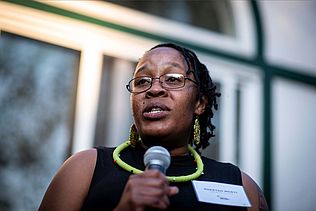
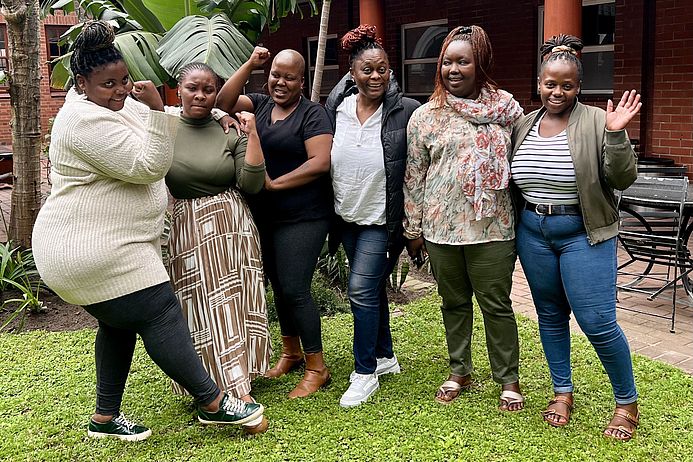
In Phephisa's 24 local self-help groups, survivors of sexual and gender-based violence support each other. Their collective process of reflection and healing also addresses the societal root causes of violence. In emergencies, the women mobilize rapid support for those affected by violence themselves.