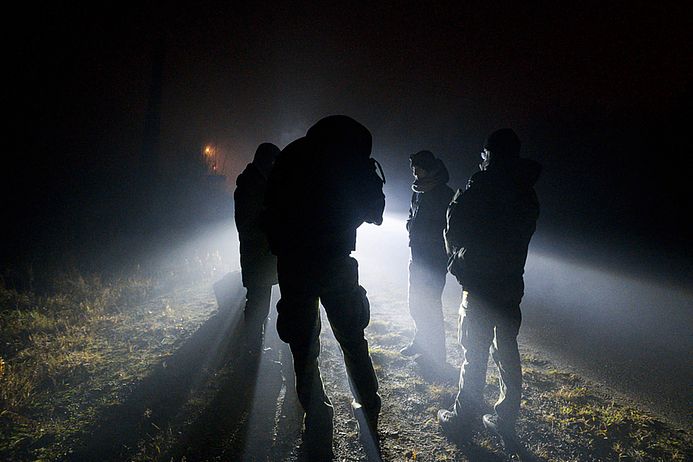
Is she ever afraid when she runs into armed soldiers alone in the forest? Małgorzata Klemens waves her hand dismissively. "I've seen too much to be afraid," she replies, almost casually. We are sitting together in her garden in the middle of the Bialowieza Nature Reserve in north-eastern Poland, surrounded by lush meadows, forest and chirping birds. On the way here, we repeatedly lost our way on sandy paths that vanished between trees, grasses and ferns. Gosia's garden, as Małgorzata is known to everyone, is a small paradise. But the idyll is disturbed again and again: military vehicles repeatedly rattle past on the unpaved road going by her house. There is a reason for this: just a few hundred metres away is the heavily fortified border fence with Belarus. For Gosia, the military presence is not only part of everyday life, but also a menace. In 2021, heavily armed soldiers entered her property and held a gun to her head. But even that did not deter her from staying.
Gosia is a photographer. Years ago, she retreated to this remote forest area to concentrate on nature photography. But things turned out differently. Four years ago, a new escape route to the EU opened up. Encouraged by Belarusian leader Lukashenko, more and more people seeking refuge – many from Iraq, but also from Afghanistan – tried to make it to Poland through Belarus. This began to transform the Bialowieza National Park and the Podlasie region: the border area became a restricted military zone. Soldiers and border police patrol the forests looking for refugees. Armed vigilante groups are also wreaking havoc in Europe's last primeval forest. Gosia witnesses all this first-hand. Nature photography has taken a back seat. Instead, she helps people who are at risk of starvation. And with her camera, she documents the injustice that is taking place here.
Unrestrained violence and pushbacks
To keep out refugees, a massive fence has been erected along the almost 200 kilometre-long border. It is 5.50 metres high, equipped with double NATO barbed wire with extra-large blades and thermal imaging cameras. Military forces and drones monitor the road that runs along the fence. "But the border barrier architecture is not designed to protect anything. It is designed to hurt people," an activist from the group "We Are Monitoring" had told us back in Warsaw. Standing in front of the wall, it becomes evident what she meant: anyone who wants to cross the wall has to jump from a height of five metres into the barbed wire on the ground, whose razor-sharp blades cut flesh to the bone.
What drives people to such desperate acts? One thing is clear: refugees who want to apply for asylum in Poland or Germany have little choice – because escape routes across the Mediterranean are even more perilous. But even here in the Polish forests, they are exposed to massive violence.
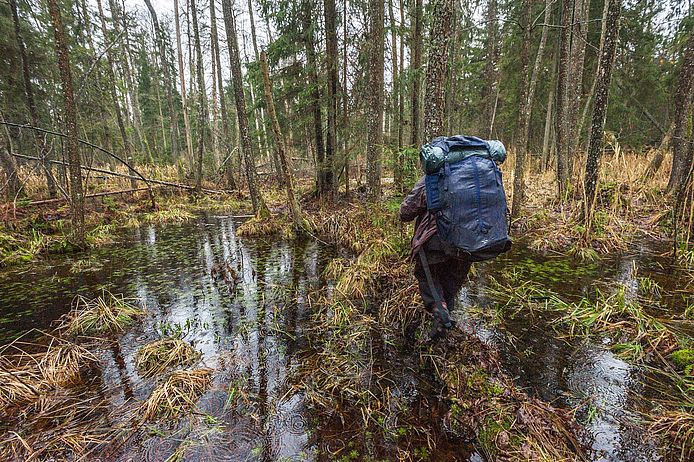
Gosia's photos and videos bear witness to this. Despite massive intimidation, she has repeatedly returned to the scenes of the crime in the forests to press the shutter button on her camera. In her garden, we look at pictures of security forces beating people with sticks; of seriously injured refugees caught in barbed wire; of people found in the woods, dehydrated, half-starved, frightened to death. The sadism practiced here reminds one of reports from war zones.
Soldiers are said to blast recordings of dogs barking through the forest to drive people – many of whom are already severely traumatised – out of their hiding places or into madness. Once they are picked up by the police and border guards, they are usually taken back across the border. Even injured people are often not taken to hospital for treatment, but are driven across the border in military trucks and even ambulances and abandoned deep in the forest. Pushbacks even take place from hospitals. Gosia has also captured this with her camera. One photo shows a woman from Somalia. She is standing on the other side of the fence, gazing in resignation through the gaps between thick metal bars into the camera. She is wearing a gown she received at the hospital in the small town of Hajnówka. It is printed with polar bears, snow-covered mountains and stars.
Nature reserve as military terrain
Katarzyna Czarnota accompanies us on our journey through the Polish forests. She herself spent years caring for refugees in the woods. Now, as a member of Border Forensics, a partner organisation of medico, she reconstructs cases of border violence. She also uses Gosia's photographs in her work. While official reports often cite hypothermia or dehydration as the cause of death, her investigations arrive at different conclusions. They show that people in the forests succumbed to their injuries or died of thirst because the military and police prevented activists from reaching and caring for them.
In Poland, violence against refugees is justified with the narrative that they are "hybrid weapons" sent by Lukashenko and Putin. Since Russia launched its war of aggression against Ukraine at the latest, the "defence of Europe's eastern flank" has become an important element in the ongoing discourse. It also serves to justify the dehumanisation to which those seeking protection are exposed here. But the presence of thousands of soldiers and other security forces in the national park, armed to the teeth and equipped with the latest in weapons technology, cannot be explained by the presence of a few hundred refugees alone. Rather, the forest has become a testing ground for heavy military equipment and the latest arms and surveillance technologies. On our drive along the narrow roads in the forest area, we repeatedly come across huge construction sites. Katarzyna explains to us that roads towards Belarus are being widened so that military vehicles and tanks can also drive on them. Forests are being cleared, swamplands drained, and flora and fauna massively impacted: in Bialowieza National Park, they are training for war.
The militarisation of the border region is making it increasingly difficult to hold the military and border police accountable for their violence. Added to this is the lifting of fundamental rights standards: at the end of March, the liberal-minded "civil coalition" led by Prime Minister Donald Tusk officially suspended the right to asylum for the eastern Polish border region. It is unclear exactly how far the suspension applies geographically. Ultimately, the government has formalised and legalised the practice of pushbacks, which has been commonplace since 2021. According to legal statute, there are supposed to be exceptions, for example for pregnant women and unaccompanied minors. In practice, however, this is not the case.
Not everyone goes along with it
"In Poland, we are seeing a securitisation of migration that is becoming increasingly relevant for the entire EU," explains Katarzyna. What began in 2021 with a military lockdown in a national park has long since become the new normal in the European refugee shield. The systematic suspension of the right to asylum in the Polish border region violates European law and the Geneva Convention on Refugees – but the EU has never initiated infringement proceedings. Germany's border controls and rejections of refugees, sending them back to Poland and Austria, are also illegal. The German government, one of the most powerful players in the European structure, has thus sent out a signal: in this age of rearmament and renationalisation, international and European law are no longer binding, and even fundamental rights can be suspended on the grounds of an emergency. The result is a state of lawlessness in which "asylum" has become an empty shell. Greece recently suspended the right to asylum for people from North Africa.
Non-state violence has also proliferated. In Poland, for example, far right-wing vigilante groups are now attacking people who are being pushed back to Poland from Germany. This development is being driven not only by the far right, but above all liberal-conservative governments. "If the previous right-wing government under the PiS had suspended the right to asylum, people would have taken to the streets," asserts Katarzyna. "The Tusk government was able to do it." In the border region, not everyone is caving in to the government's policy. Aid workers continue to care for refugees in the forest as best they can. Katarzyna and Gosia know of many people here who do not call the police when those seeking protection knock on their doors, instead providing discreet support. "In the villages along the border, almost every family has members who work for the border police," says Katarzyna. "But there is also almost always someone who has already helped people fleeing."
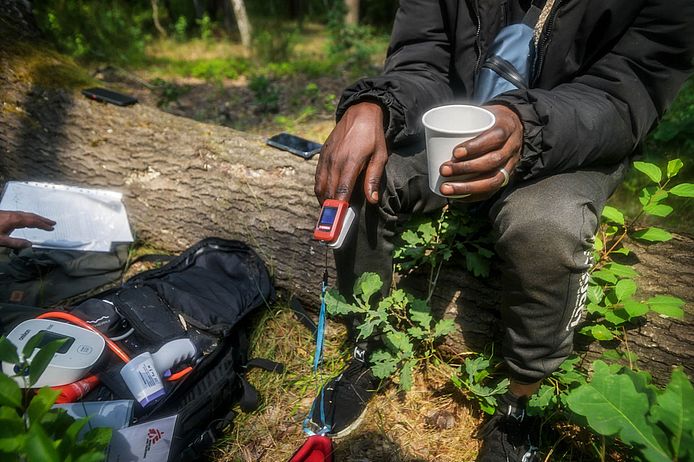
Activists from other parts of the country have also come to the border area to offer practical solidarity. Many have joined forces to form the Grupa Granica network. Their efforts are supported from Warsaw, where the We Are Monitoring initiative operates an "alarm phone". When refugees in need of assistance in the forests contact the service, activists in the so-called Basas are informed. These are places in the forest area from which the activists set out with clothing, food and first-aid kits to search for those seeking protection – in the hope of finding them before the military or border police do. At the same time, We Are Monitoring documents state violence: since 2021, the initiative has recorded around 11,300 pushbacks and over 100 fatalities. The actual figures are likely to be much higher. Even though this work is legal, there have been several house searches and activists repeatedly end up at police stations.
Legal violence, illegal help?
We meet Ewa Moroz-Keczynska in a small village in the forest. The ethnologist is head of the education department at Białowieża National Park. Ewa was born here and returned after completing her studies in Warsaw. Hardly anyone understands the local ecosystem as well as she does. She is deeply concerned about pollution of the waters and the disappearance of wolves due to the construction of the border fence. The people of the region know Ewa, many from an early age. Today, she is admired by most and sought after for advice. Others avoid her. But even right-wingers in the region do not dare to attack her publicly. Why does she polarise other people so much? Ewa is a central figure in supporting refugees. It all began back in 2021. "When I stumbled upon starving people in the forest, I couldn't look away," she recalls. She helped with clothing and food. In March 2022, she was arrested along with four other activists while helping a Kurdish family find their way out of the forest and into the village.
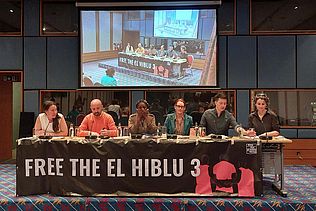
The next time we see Ewa is in September, sitting in the dock alongside the other activists. They are known as the Hajnówka 5. Citing Article 264a of the Polish Criminal Code, the public prosecutor's office has contrived a charge of "aiding and abetting illegal residence in Poland". They face up to five years in prison. The trial has been moved to Bialystok, in the largest courtroom there, so that it can accommodate all the journalists and interested members of the public. Everyone is eagerly awaiting the verdict. medico's Polish partner organisations are also present: lawyers from the Helsinki Foundation for Human Rights and the Szpila collective, who have been supporting the defendants from the outset and are providing expert testimony on the charges in court. Their goal is to set a positive precedent that makes it clear once and for all: flight and solidarity must not be criminalised.
At the end of the trial, Ewa stands up for her closing statement. She looks the public prosecutor in the eye and asks: "If saving health and lives is a crime, what is indifference? If we are convicted today, it is not only a condemnation of helping others, but also of normal human decency. Our acquittal would remove the stigma of crime from an entire community that has placed humanity above indifference or hostility in the most difficult of times. Let me continue to believe that it is worth being decent." The judge acquits the defendants on all counts. Because helping others is not a crime, he says.
Since 2021, medico has been supporting networks that defend the rights of those seeking protection along the Polish-Belarusian border. Our partner organisations also provide emergency humanitarian aid, medical care, psychological support and legal advice to refugees and migrants in other locations along the EU's external border. For the right to a life in dignity – everywhere.
- Donation reference: Flucht & Migration (Flight & Migration)