When your work has involved Palestine and Israel for a long time, you no longer allow yourself to get your hopes up too quickly. And medico’s work has involved Palestine and Israel for a very long time – long enough to have learnt what the editors of the anthology ‘Daybreak in Gaza’ reminded us of in October 2025, when they visited us at medico headquarters in Frankfurt am Main. Mahmoud Muna from occupied East Jerusalem – a bookseller whose store in Sheikh Jarrah has been targeted by the Israeli police multiple times – and Matthew Teller, a historian and writer from England, brought an important message with them to Germany. It was a plea from people in the Gaza Strip, whose stories Muna and Teller collected in the book. The message could not be simpler, though putting it into practice often proves difficult in the face of what is happening in Palestine, across the entire region and even the world. The response from Gaza to the question of ‘How can you still hope?’, was ‘How can you not? We cannot afford to give up hope if we want to go on living. So please don’t stop talking about Gaza. Find the strength to keep going.” Sounds pretty simple, doesn’t it? And also infinitely difficult, doesn’t it?
The year 2025 had so many lows when you look to Palestine. And yet the atrocities of the second year of the genocide strangely blur with those of the first. Was the war in 2024 really more brutal, or did it just seem that way because the shock in the first year ran even deeper after every act of cruelty? Is brutality objectively measurable? Could the different perception of the two years perhaps also be down to the two ‘ceasefires’ in 2025 – first between mid-January and mid-March, and then again since October?
Ceasefire here, Operation ‘Iron Wall’ there
If you looked closely at the situation, it was more a case of briefly catching your breath than drawing real hope. It is true that, in the scope of that first ceasefire last year, the Israeli government did indeed allow more aid deliveries into Gaza as agreed, and during the two months of the ceasefire it also allowed more patients to leave for medical treatment than in any comparable short period before or since October 2023 – including the ceasefire that has remained in force since October 2025. But the truth is also that, just two days after the ceasefire entered into force in the Gaza Strip on 21 January 2025, the Israeli army launched Operation ‘Iron Wall’ in the West Bank. The name was no coincidence - ‘The Iron Wall’ is also the title of a 1923 classic by revisionist Zionist Ze’ev Jabotinsky, who openly advocated driving the entire Arab population out of Palestine.
This operation and previous military campaigns have caused up to 40,000 people to be displaced since October 2023, mainly from three refugee camps: two in Tulkarem and one in Jenin. Hundreds of homes have been systematically destroyed, either demolished by military bulldozers or blown up. The D9 bulldozers also made parts of the camps’ infrastructure useless by destroying the water supply and sewage networks and tearing up roads. In Jenin, in late October 2023, the army destroyed the Al-Hissan monument, a sculpture in the shape of a horse which had been erected from the wrecks of vehicles and rubble from houses during the Second Intifada as a symbol of the camp’s resistance and resilience (incidentally, by a German artist, Thomas Kilpper, in collaboration with twelve teenagers from the camp). Two days earlier, the army had also destroyed the memorial to Palestinian journalist Shireen Abu Akleh, who was murdered by an Israeli sniper in Jenin in 2022. The entrance to the camp through the ‘Arch of Return’ did not survive the army’s destructive frenzy either.
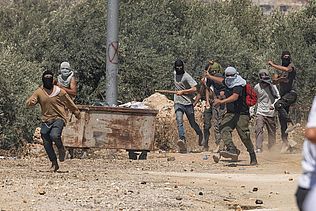
During the same period, in the C areas under full Israeli control – which make up around 60 per cent of the occupied West Bank – 58 communities were forcibly displaced from their villages and hamlets from October 2023 down to the present day. In another 17, some residents have already given in to the constant violence from settlers and the Israeli army. Generally, these have been very small communities that made their living from sheep farming or wage labour and had faced regular attacks from settlers for many years. A considerable part of the population is children. When attacks like this happen with increasing frequency and become ever more brutal and deadly, parents are eventually faced with the choice of giving up their livelihoods or seeking a safer environment by fleeing. Under occupation, children quickly learn the painful lesson that their parents cannot protect them.
At 1,828 acts of violence against Palestinians in the West Bank alone in 2025, a longstanding trend continued. 1,828 acts of violence in an area equivalent to one third of the German state of Thuringia are also an alarming record. Nationwide in Germany, there were 1,521 acts of far-right violence during the same period. And this comparison does not even begin to reflect the vast numerical differences in the size of the victim groups and the pool of potential perpetrators. Incidentally, in the occupied territories we are also talking about crimes that are generally far more serious than those recorded in Germany: murder and manslaughter, grievous bodily harm, robbery. These include over a thousand Palestinians killed or murdered since 7 October 2023, at least 29 of which at the hands of settlers.
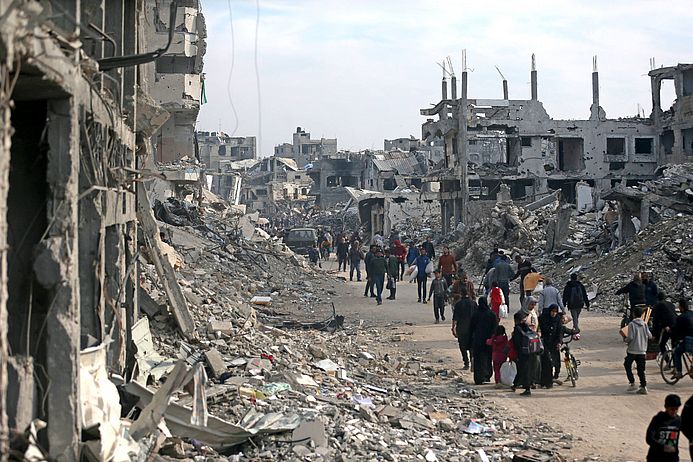
These events unfolded as the brief and fragile ceasefire in Gaza came to a premature end. The Israeli government had effectively already stopped allowing aid deliveries into the enclave from the beginning of March. From 19 March, it unilaterally terminated the ceasefire and started bombing Gaza again and systematically demolishing residential buildings. The escalating policy of starvation over the summer months of 2025 marked a new low in this genocidal warfare. The people of Gaza, who by this point had already endured nearly two years of mass displacement and homelessness in violation of international law, as well as the withholding of humanitarian aid, were already emaciated when these draconian measures further exacerbated the shortage of basic goods essential to survival.
Our partners in Gaza and the West Bank had no choice but to carry on their work in the midst of all this. Between the Jordan River and the Green Line, they met the basic needs of parts of the population – numbering in the thousands – who had been displaced to the refugee camps in Jenin and Tulkarem, as well as of the destitute urban population, who had been plunged into mass unemployment and poverty overnight following the blanket withdrawal of work permits for Israel and the illegal settlements after 7 October 2023. They tried to stop land and property from being forcibly taken over by settlers through agricultural cooperatives, whilst using the produce grown there as a practical expression of solidarity with their compatriots. They helped repair homes damaged by the Israeli army.
In spite of it all: emergency aid, mobile clinics, psychosocial support, school lessons and much more
In Gaza, despite all the destruction, they provided education to thousands of children in big makeshift tents. This project was not safe from attacks either and was temporarily destroyed in the early summer. Two colleagues from the Mayasem Association were shot dead whilst attempting to salvage what could still be used in the wake of Israeli bombing. The Culture and Free Thought Association is providing medical and psychological support at decentralised, mobile locations, focussing on women, children and young people. One of the organisation’s medical centres in Al-Rimal offered many women in Gaza City access to essential services that would otherwise have been difficult for them to reach or would have entailed even greater danger.
Since 10 October 2025, a ceasefire has supposedly been in place in the Gaza Strip. But the terms have been violated from the start. This continues down to this day, with the Israeli government enjoying total impunity. Many hundreds of people have been killed by the Israeli armed forces in Gaza since October 2025. The situation is no different in Lebanon. In contravention of the agreement for the first phase of the Trump-Netanyahu plan, humanitarian aid to Gaza remains hugely restricted. The Israeli army has systematically destroyed homes to prevent their Palestinian inhabitants from returning. We see the same dynamics at play in southern Lebanon. This is not just our analysis; Israeli politicians are also drawing parallels with the Nakba – the mass displacement that took place during the founding of the State of Israel. So what we have often stated is, unfortunately, proving true: nothing in the toolkit of this oppression is new. These tools are simply being applied with varying intensity at different times. But what is equally true, both for our partners and for us, is that if the project of land seizure and displacement is intent on prevailing in the long term, then so are we. All the more so when people from Gaza still find the strength to encourage us here in Germany. They cannot afford to lose hope there. And neither can we.