By Anita Starosta and Timo Dorsch
At the unofficial Iraqi-Syrian border crossing at Fishkhabour-Semalka there is a gaping void. The familiar hustle and bustle at the baggage check, the long queues at the counters, children playing to pass the time – all gone this time. We cross the border in an almost empty minibus, which drives over the rickety Panton Bridge across the Tigris. Numerous lorries loaded with aid supplies from the Barzani Charity Foundation in Kurdish northern Iraq, which are waiting to cross into north-eastern Syria, give us an idea of what lies in store for us over the next few days. The camera crews from the Kurdish TV stations are already positioned on both sides of the border. Aid is always a show as well. It is the end of January and we have decided to support our partners in Rojava by visiting them on-site.
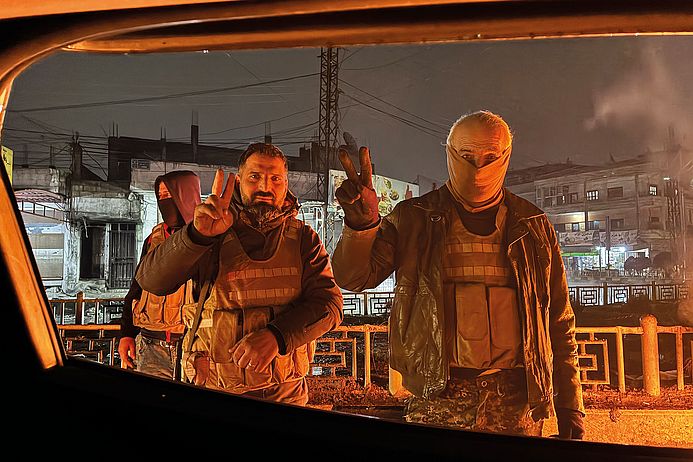
Since the military offensive launched against the Kurdish districts of Aleppo on 8 January by the Syrian transitional government under Hay’at Tahrir al-Sham (HTS) and its affiliated Islamist militias, events in northern Syria have come thick and fast. As negotiations between HTS and the Syrian Democratic Forces of the Autonomous Administration (SDF) broke down, HTS units made a surprise advance, capturing not just the predominantly Kurdish districts of Sheikh Maqsoud and Ashrafieh in Aleppo, but also advancing into other Arab-dominated areas that were under the military control of the Autonomous Administration. In the space of a few days, HTS, with the participation of affiliated Islamist militias, captured cities like Tabqa and Raqqa, as well as the Deir ez-Zor region – also to the cheers of the local Arab population. But that was not all: a few days later, the symbolically charged Kurdish border town of Kobane was surrounded by HTS. Ceasefire agreements were broken repeatedly, Kurds were killed and driven out, prisons were opened and IS fighters released. Several staff of medico’s partner, the Kurdish Red Crescent (KRH), were abducted for a time; KRH ambulances and clinics were burned down, and the KRH headquarters in Qamislo even became the target of a night drone strike. Tens of thousands of civilians fled from the attacks in panic. The region controlled by the Autonomous Administration, which up until then had accounted for a third of Syrian territory, thus shrank to almost half its original size.
Reconciliation? In tatters
Later, medico’s partner organisation, the Rights Defense Initiative (RDI), reported about an orchestrated propaganda campaign on social media launched by HTS-aligned channels ahead of the military offensive. “False reports of the SDF committing massacres and desecrating corpses were circulating and inciting the Arab population against the Kurds,” is the conclusion their social media analysis draws. The mood that this engineered created a scenario that was advantageous to the transitional government. “There was also hate and incitement to hatred against the Arab population from the Kurdish side, but this was neither coordinated nor collective. Unfortunately, there was no third-party source recognised by all sides that could have refuted the fake reports,” continues an RDI employee at the radiator-heated office in Qamislo, concluding: “There is a clear media strategy by HTS, and this will continue to be felt in the reconciliation process going forward.” How this can continue is not something the team knows either. Right now, everything is in tatters. For years, they have given workshops at various locations throughout the country, across all ethnic and religious divides, to facilitate joint dialogue and mutual recognition. Last September, we took part in one such gathering in Raqqa. Even then, the spread of hate speech on social media was a major issue, with representatives of Arab tribes also stressing the danger posed by social media: hate speech was everywhere, they said. Now the cautionary words from back then sound like an ominous premonition.
The hardship is escalating
Faced with the violence unleashed by HTS, Islamist militias and IS units, at least 100,000 people have fled to the main territories of the Autonomous Administration. Currently, it is a bitterly cold, wet winter there, which does not stop at the doors of the makeshift emergency shelters. The internally displaced are crowding into schools, mosques and empty buildings in Qamislo, Dêrik and Amude. Verified figures are virtually impossible to get. A member of the Kurdish Red Crescent staff shows us a list: in Qamislo alone, there are 130 emergency shelters for the nearly 50,000 people who have arrived in January. We visit several of these shelters. The KRH response teams organise emergency aid, whilst RDI records statements from the refugees and documents crimes committed. The accommodation conditions and the people’s stories are all too similar. Everywhere we encounter tired faces, exhausted bodies, and desperate hearts. The windows of the shelters are broken; bitter cold has found its way into every corner. There are no cooking facilities, let alone any hygiene standards.
Years of Turkish drone strikes have destroyed the city’s power grid. Thanks to diesel generators installed next to buildings, water pumps can be switched on for brief moments. But along with the oil stoves, they pollute the air. Lung diseases and chronic headaches are the result. At first, it was mainly privately organised aid initiatives from the neighbourhoods that supplied people with the basic necessities. The people of Qamislo donated hot meals and clothing. Professional aid has now ramped up; over 200 lorryloads from Kurdish northern Iraq have arrived, and the KRH is working round the clock. But it is not enough. Other international aid, from the United Nations even? You can basically forget it. The UN sent just two convoys, each with 25 lorries, to besieged Kobane – a pretty symbolic gesture given the more than 200,000 people there.
Displaced, yet again
At private emergency accomodation, we speak to a family who have fled as we sip instant coffee and warm ourselves by the oil stove. “Why must we Kurds from Afrin suffer so much?” laments the man. His wife is sitting on a mattress in a corner; her left arm is bandaged. She was shot whilst they were crouching in the back of a pick-up truck as they fled. In Hasakeh, they took his father to the local hospital. A bullet had hit his kidney. He died. And because the local morgue was already too full, they took him all the way to Qamislo. Here, in the cold and snow, they spent hours digging a grave in a cemetery. The man’s voice trails off. Sitting opposite him is his young daughter. Her pink jumper reads: “Do you love me?”.
The family’s story is not an isolated one. For many of the displaced, this is already their fourth or fifth time fleeing in the space of the last eight years. Many come from Afrin, fled to Shehba or Sheik Maqsoud in 2018, then to Tabqa, from there to Raqqa, Hasakeh, and now to Qamislo. They share similar experiences of violence, miss their loved ones, have lost a family member as they fled or have been seriously injured. Nobody here believes the promises of those in power in Damascus that they might one day return; the distrust towards all those who have inflicted violence upon them, occupied their homes and taken everything from them runs too deep. What they share though is the desire to return to Afrin, to their olive groves, to their homes, where they could lead a simple but good life, and where their children could go to school and learn Kurdish.
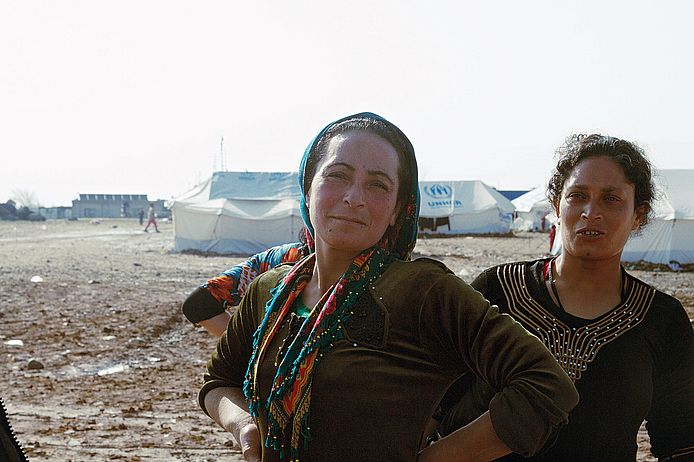
The lack of prospects and the sense of helplessness are also evident at the Newroz camp in Derik. It was set up with medico support in 2014 by the Kurdish Red Crescent for Yazidis who were forced to flee the genocide in Shengal. Since 2019, nearly 5,000 displaced people from the Serêkaniyê region have also been housed in tents in this now officially recognised UN refugee camp. There is currently no space for additional emergency accommodation for the hundreds of families who have arrived from Sheik Maqsoud or Tabqa over the past two weeks. The lack of funds and time mean people are left to endure the conditions in the mud. The emergency aid workers can no longer cope with the situation. During our conversation, the co-chair of the camp bursts into tears: “We need help from outside.” The members of her team have been working non-stop for two weeks. Since the cuts to USAID funding, they have had to improvise at every turn. “What are your governments doing? Why is everyone letting us down?” she asks desperately. It is something, a mixture of question and accusation, that we will hear many times over the next few days.
Had Israeli, French and US government representatives not given the Syrian interim government the green light for the planned military offensive at a meeting in Paris on 4 January, the situation would be very different today. The SDF, long-standing partners in the fight against the Islamic State as part of an international alliance, were ditched just as interim President al-Sharaa began to enjoy diplomatic recognition and showed himself willing to grant foreign capital access to Syrian resources and infrastructure. The sudden U-turn by Western governments proved once again that the shifting self-interests of states decide their strategies.
Doubts about the agreement
The new global and Syrian power constellations and the violence against Kurds, led to a new agreement between the SDF and the authorities in Damascus being concluded under time pressure, establishing a ceasefire and territorial boundaries. The agreement was announced on the afternoon of Friday 30 January. It did not trigger jubilation from the population in Qamislo. Over the weekend, more and more details emerged, which we discussed extensively with our medico partners during car journeys, over tea or at the offices. To begin with, the mood was dominated by a sense of incomprehension at an agreement with those responsible for the violence against their own people. The fear of HTS fighters who might be stationed in Hasakeh and Qamislo is great and legitimate – as is the incomprehension at a possible final blow against the Rojava project, which countless people have kept alive for years with great sacrifice, suffering but also dedication.
The subdued mood is also tangible when we meet Evin in Hasakeh on Saturday. This confident woman once ran the orphanage supported by medico and was chair of the women’s commission. As the front line reached just a few kilometres from the city, she says, the streets were deserted. Terrifying news had reached them from Raqqa, where HTS fighters were compiling lists of female residents who had campaigned for women’s rights. Even the local cultural centre there with music and art classes run by an Arab feminist, had been destroyed. The director had suffered a heart attack as she witnessed the destructive rampage. “Rojava is always a project to reimagine democracy. The attack against us was not an attack against Rojava alone, but against this new idea of democracy,” stresses Evin. The television playing in the background shows footage of the mass demonstrations in Europe.
New Kurdish unity?
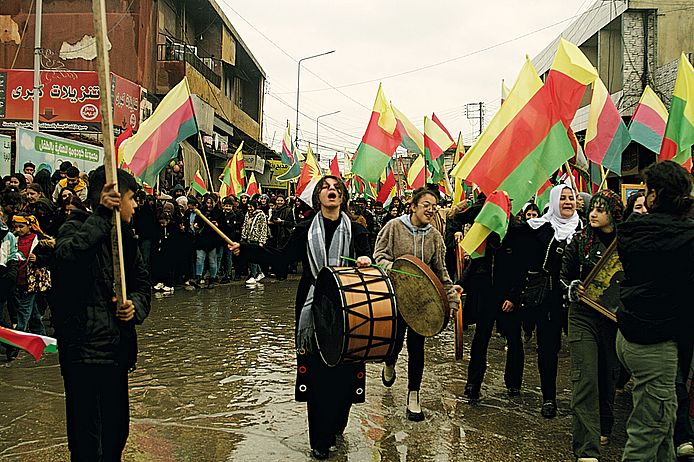
During these days of uncertainty, Kurdish unity has grown stronger. Whilst the streets of Qamislo used to be dominated by the flags of the local self-defence forces of the YPG/YPJ or portraits of Öcalan, the Kurdish flag now flies by the roadside. Children stand by the roadside chanting slogans of Kurdish unity. Fighters from other parts of Kurdistan crossed the border and joined the defence of Rojava. Just a few hours before the agreement was announced, a funeral was held in Qamislo for a fallen fighter who had come from northern Iraq. Even the President of the Kurdistan Region of Iraq, Necirvan Barzani – otherwise close to Turkey – is expressing solidarity with his Kurdish brothers and sisters and acting as an advocate for the SDF and Autonomous Administration. He will see some benefit in this. And because the idea of democracy is not purely Kurdish, nor is it solely that of the Autonomous Administration, there have been numerous expressions of solidarity from Europe. In Qamislo, we met a delegation from Switzerland. A convoy, whose members came from several European countries, made it as far as the Turkish-Syrian border. The Turkish government took their solidarity with democracy as a chance to crack down on them, detain them and deport them.
What happens next?
The agreement of 30 January sets forth the integration of the Autonomous Administration into the central Syrian state – similar to what was already set out in an agreement of 10 March 2025. The fact that its implementation took so long was due not least to the massacres of the Druze and Alevi minorities, which HTS units were also involved in. This violence also served as a warning to the Autonomous Administration: if you give up your protection you become a victim. It served as a red line during the recent negotiations. Now, 15,000 Kurdish fighters, including female fighters from the YPJ women’s unit, are to be integrated into the Syrian military as a separate military division with three units. The governor’s office in Hasakeh will be staffed by Kurds, a first in Syria’s history; the city of Kobane will be incorporated into the Aleppo governorate but will remain autonomously administered. Civil society organisations and media outlets will continue to operate but have to register in Damascus and will be subject to Syrian law. School and university qualifications from institutions under the Autonomous Administration will be recognised. The return of all displaced persons to Afrin, Serêkaniyê and elsewhere is also to be made possible. Former employees of the Autonomous Administration will become part of the central Syrian state apparatus, and civilian institutions will also be integrated. At the same time, though, all the oil fields will go to the central Syrian Ministry of Energy, thereby sealing the end of economic independence. The airport in Qamislo and the border crossings into Turkey and northern Iraq will be overseen jointly by Damascus and the Autonomous Administration.
The implementation of the agreement is already a litmus test now for the country’s future. Will peaceful integration succeed in spite of the lack of security guarantees for the country’s minorities? Is a process of social reconciliation feasible in the future – and is it even conceivable? Despite all the despondency and bitterness, over the last few days we have also heard from medico’s partner organisations in Rojava of a determination to carry on. But it is carrying on with the handbrake on, or as one of the people we talked to put it: “It is the transitional government’s last chance to recognise the Syrian minorities and engage in politics with them. Should that fail, it will mark the beginning of Syria’s renewed fragmentation.”
For over twelve years, medico has supported the project of Democratic Autonomous Administration in North and East Syria. Be it emergency aid for displaced people, women’s rights or human rights work – long-standing cooperation projects connect medico to the people in the region. Even though the future is uncertain: with your support, we will continue to stand with our partners – be it through direct aid for displaced people in emergency accommodation, the documentation of human rights abuses or public relations work here in Germany.