Whether it's interminable hours of piecework at the sewing machine leaving them with crooked and bent backs, toxic fumes that attack their lungs, or not getting paid when they are sick, forcing even ill seamstresses to report for duty: working in Bangladesh's teeming textile factories is extremely harmful to health. The minimum insurance required by law usually exists only on paper, which means that workers often have to pay for medical treatment out of their own pockets and risk losing their jobs if they miss work. Illness makes people poor, poverty makes people ill. medico's partner organisation Gonoshast haya Kendra (GK) is attempting to break out of this cycle with a pioneering collective health insurance project.
But first things first. In Europe, decades of struggles by workers and their trade union organisations in the 19th and 20th centuries not only secured better wages, shorter working hours and occupational health and safety laws and regulations. It also gave rise to company health insurance funds financing and developing healthcare and in some cases preventive care services. This social contract, dubbed "Rhenish capitalism", has been rolled back or circumvented in the course of globalisation in recent decades, with many companies offshoring parts of their "workbenches" to other countries and regions of the world. As a result, most of the jeans, T-shirts and jumpers worn in Europe today are manufactured in South and Southeast Asia.
Exploitation jeopardises health
In Bangladesh, textiles account for 80 per cent of exports. In satellite towns such as Ahulia, Panishail and Tongi dotting the outskirts of the capital Dhaka, around four million workers produce goods totalling US 35 billion annually. This has provided many Bangladeshis with a livelihood, and young women in particular have become less dependent on their families and husbands. The downside: even though wages have risen in recent years thanks to industrial action and union organising efforts, they remain well below what would amount to a living wage due to pressure caused by intense international competition in the ready-made garment sector. Production is based on feebly regulated exploitation and a dearth of occupational health and safety. Accidents at work are commonplace and working conditions are highly stressful.
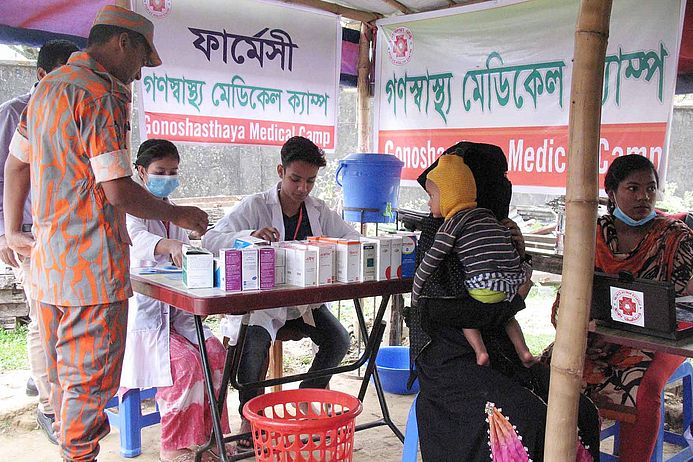
For several years now, Gonoshasthaya Kendra has been working on behalf of the country's new class of industrial workers. This too has been a long journey. Fifty years ago, GK set about building a network of grassroots health facilities in rural areas founded on solidarity. True to the slogan of its founder, Zafrullah Chowdhury, "small is beautiful, but big is necessary", the organisation has gradually evolved into one of Bangladesh's largest non-governmental health organisations. Its health workers care for more than a million people in all parts of the country. They impart medical knowledge and information about nutrition and family planning. The medico partner has also fought to develop the country's own drug production and now manufactures many essential medicines itself. Disaster relief is also an element of GK's work, for example in response to the frequent hurricanes in the Bay of Bengal. When the Rana Plaza textile factory collapsed not far from GK's headquarters in 2013, burying more than 1,000 people under the rubble, GK provided immediate emergency aid and rehabilitation for the survivors. This marked the beginning of the organisation's commitment to providing health insurance for textile workers.
In many ways, this was uncharted territory for the organisation. Unlike in rural areas with stable village social structures and local authorities, GK has to deal with urban industrial living environments characterised by much greater mobility among their various communities, complex social conflicts, trade unions, and large and small textile companies. In this complex situation, GK has tested various concepts for health programmes for workers in the garment industry.
Free treatment
Through systematic persuasion, it has been possible to conclude contractual agreements in which GK itself acts as a kind of "collective insurer". At present, the entire workforces of five companies are covered by health insurance – over 20,000 workers, and at one company their families as well. An annual solidarity contribution of 600 taka (approx. EUR 4.30 at the current exchange rate, or less than 0.5% of wages) is paid for each worker, half of which is initially paid by the factory and the other half by an external donor, specifically medico. The factory's share is supposed to gradually increase until it covers the full amount. Within the programme, employees can receive free treatment at one of GK's health services. In addition to outpatient care on site at small health stations during working hours, they can also use GK's own regional health centres and the GK hospital in nearby Savar. Thus, even more complex illnesses can be treated.
Experience has been positive. Participating physicians report that, thanks to the ready accessibility of care, workers not only report work-related injuries or exhaustion. They also seek help for ailments that they had previously unsuccessfully tried to treat themselves with freely available medication from pharmacies, and whose professional diagnosis can prevent more serious outcomes. One worker notes that the rapid and inexpensive availability of medical treatment also reduces the mental stress associated with the high costs people know they will incur if they take ill. Finally, the factories' human resources departments also express their satisfaction with the model. The insurance coverage has boosted job satisfaction, leading to fewer workers changing jobs. Timely treatment also shortens the course of an illness, thereby reducing absenteeism.
The insurance contributions effected by the companies are currently too low to cover all the necessary expenses, however. The project therefore remains dependent on external subsidies such as those provided by medico. GK's strategy is therefore to attract even more companies to the scheme, thereby enabling it to operate closer to a cost-covering basis. The obvious solution of raising contributions has so far proved difficult to put into practice, as companies would then opt for other insurers. Independent analyses have shown that workers would like to have their insurance benefits expanded.
Will the model catch on?
The GK model demonstrates that it can work. In order to substantially improve healthcare in the country for as many people as possible, however, binding regulations from the labour authorities are absolutely essential. To this end, the low insurance contributions paid by companies in the textile sector and outside it need to be gradually increased. In fact, the Health Care Reform Commission, which was set up by the transitional government after the fall of the Awami League in the summer of 2024, has made some constructive proposals to strengthen the public health sector. This is also due to the influence and lobbying efforts of GK. Activists rightly point out, however, that GK forwarded proposals like these 30 years ago and that these will be even more difficult to implement in the country's now largely privatised health system than they were back then. The fact remains that small steps are all well and good, but big steps are necessary.
Dr Andreas Wulf is an emergency aid consultant at medico, working on global health issues. Together with his colleague Felix Litschauer, he recently visited Bangladesh to view the Solidar project run by Gonoshasthaya Kendra with his own eyes.
medico supports both the campaign for better working conditions and a properly functioning health insurance system in Asian textile factories and demands binding human rights standards be implemented in global supply chains.