When a character like Donald Trump promises Gaza "eternal peace" and is buoyed in his efforts by the Machiavellian Benjamin Netanyahu, who is wanted for crimes against humanity, it warrants a closer look. And if you take a closer look, you will quickly realise that regardless of whether phases 2 and 3 of this plan are being negotiated and what the exact outcomes may be, it will have little or nothing at all to do with peace for the Palestinian people. Rather, it is to be feared that they will be violently put down, pacified in the interests of Israel, that they will continue to be subjugated to some sort of protectorate, which could well turn out to be a permanent provisional arrangement, just like the Oslo peace process, which resulted in many things, but not peace. Except in Gaza all this will be taking place under far worse conditions.
There, the weapons are finally to be silenced – with the predictable usual exceptions. The significance of this cannot be overestimated, because the difference is literally a matter of life and death for 15 to 150 people every day, extrapolating the average kill rates for the Israeli army during its genocidal campaign against the Palestinian population in Gaza in recent weeks. This is of course only counting those fatalities caused by direct military violence. Indirect victims who have died as a result of the systematic destruction of their livelihoods and the demolition of the health-care system are not included in these figures. Nor are the thousands of bodies still lying under the rubble.
Relief and uncertainty in Gaza
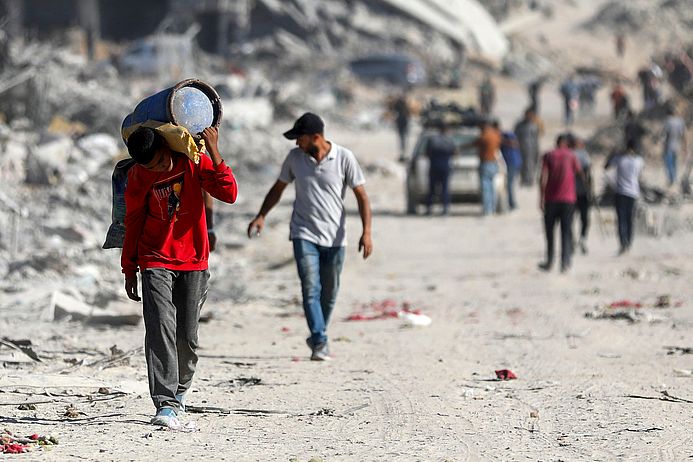
There is of course a sigh of relief in Gaza that at least this mass murder seems to have come to an end for the time being. Our partners express myriad sentiments. While some are cautiously optimistic that there will be more food available in markets again and prices will fall, others are beleaguered by an ominous, dark wave: Now that they no longer have to fear for their lives day in, day out, now that they no longer have to face every single night with the uncertainty of whether they will live to see the dawn of the next day, they realise the extent to which their lives have been ruined. Their very existence has been demolished, and no ceasefire in the world will undo this. No deal will rebuild the houses and make the contaminated fields shrouded in grey dust and debris bloom again. No promise of a Riviera will bring the dead back to life. And yet, the most important thing at the moment seems to be that the survivors, despite all their conflicting feelings, despite all their despair and hope, have the will to rebuild their homes.
But that is precisely where the problem will lie, judging both by historical experience and by all that is known about Trump's and Netanyahu's plans. Damage caused by war has never been repaired in the wake of previous desolations of the enclave. So-called dual-use materials, i.e. those that can be used for both civilian and military purposes, have been subject to the strictest import restrictions for around 20 years. The Israeli government went well beyond the lists customarily based on international standards such as the Wassenaar Arrangement. Following the devastating attacks on Gaza in 2014, for example, the United Nations was not even able to import the wooden strips used to repair room doors because they exceeded a certain length. Of course, the Israeli occupation authorities have also deemed cement and structural steel to constitute dual-use goods for years. Such strict regulations have always been justified on the grounds of "legitimate Israeli security interests".
In other words, the Israeli government has always managed to make life difficult for aid organisations and the Palestinian population, while Hamas has been able to obtain the materials it needed for its tunnel construction elsewhere anyway. Contrary to repeated claims by the Israeli government, however, these materials are unlikely to have come from reconstruction projects run by international organisations, but rather from the free market or the black market. Any aid project that needed to import materials such as cement, steel, solid wood or similar items for construction work in Gaza could only do so with Israeli permission, however. In order to apply for this authorisation, the Israeli occupation administration CoGAT required, among other things, the building plans, the quantity of materials required and the GPS coordinates of the construction site. Without this information, it was simply impossible for aid organisations to import building materials into Gaza. Meanwhile, new Israeli regulations are giving rise to fears that access for international NGOs will be further restricted or even completely denied if they do not fall in line behind the wishes and desires of the Israeli government.
The legitimate desire for security of the Palestinian population under occupation and in a state of permanent siege has played no role in this. The right to self-determination and the need for security after repeated military campaigns that were never directed solely against militant groups in Gaza, but always disproportionately affected the civilian population, also play at most a rhetorical role in current scenarios.
International troops?
The states in the region that are supposed to support the new agreement have already been duped: the final text of the accord that was published no longer corresponded to the version agreed upon by Trump, Egypt, Qatar and Turkey. The Israeli government was allowed to make subsequent changes to suit its own interests. Although the Israeli leadership has little interest in the notion of an international force in Gaza, it does not dare to openly oppose the U.S.. The opposition in Israel, often portrayed in the West as moderate, is pushing the government forward by bemoaning a loss of control in Gaza. With an international force at Trump's whim and mercy, it would be more difficult for the Israeli army to continue to behave there as it has been doing in Lebanon for almost a year, despite the ceasefire: According to UNIFIL, since the ceasefire entered into effect it has killed 270 people and injured around 850 with 950 shells and 100 air strikes based on figures from the Lebanese Ministry of Health. Repeated Israeli attacks on UN peacekeepers show, however, that even the presence of foreign troops does not guarantee security. Gaza could face a similar situation.
Hamas is also unlikely to welcome the possible presence of another force. It has managed to regain control since the onset of the ceasefire. Although it has improved public order, its return has been accompanied by serious human rights violations, including extrajudicial executions. Victims include people accused of collaborating with Israel or who participated in looting during the genocide with the support of the Israeli army, during which they are also said to have murdered Palestinians. Meanwhile, the reputed Gaza Community Mental Health Programme reports that armed men, presumably Hamas members, forced staff and patients at their facility to vacate the building at gunpoint. They then promptly moved their own families into the building. Such arbitrary actions will hopefully come to an end in any future scenario.
The people of Gaza can only hope that they will not continue to be crushed in the crossfire between the various actors. Their rights, including, but especially, the right to self-determination, have so far found no mention in the practical formulation of Trump's ideas for "eternal peace". Rather, it is to be feared that "no peace treaty should be considered valid if it has been made with the secret reservation of the material needed for a future war. For then it would be a mere armistice, a postponement of hostilities, not peace, which means the end of all hostilities, and to which the epithet 'eternal' is already a suspicious pleonasm," as Immanuel Kant put it in his essay "Perpetual Peace". The plans do not yet resemble any arrangement that would be worthy of being called peace.
Riad Othman has been working as a Middle East consultant for medico international in Berlin since 2016. Prior to that, he was medico's office manager for Israel and Palestine.