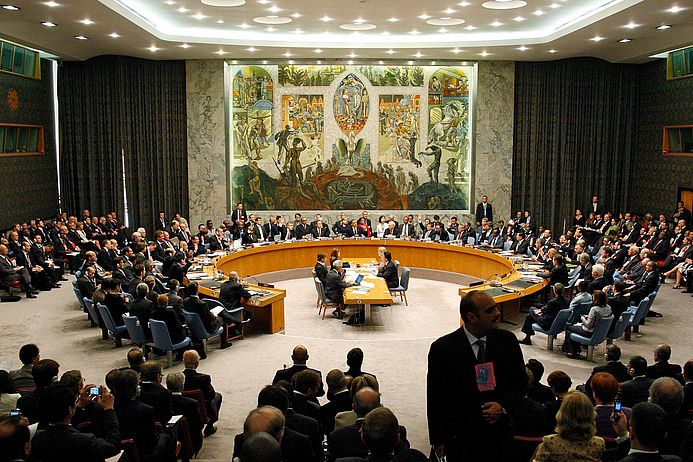
On the night of 17 November, the United Nations Security Council approved Resolution 2803 (2025) with a vote of 13-0 with China and Russia abstaining. This Resolution codifies US President Donald Trump’s 20-point plan for Gaza, which creates an International Stabilization Force (ISF) and “may finally (create conditions) for a credible pathway to Palestinian self-determination and statehood.”
This led the UN Special Rapporteur on the Right to Housing to comment “this shameful resolution on Gaza by the UN Security Council is fundamentally inconsistent with international law. It is a colonial fantasy which has little precedent in the UN’s history. It will likely fail and must be rejected by all States and individuals.”
In traditional Trump style, the resolution invokes the vaguest of language in terms of rights and open-ended language about actions able to be taken by the Israeli army, currently on trial for genocide in Gaza to continue its occupation and attacks in the Strip.
This resolution will place Donald Trump as a supreme guarantor of anything and everything Gaza related, until the end of 2027 through an undefined entity called the “Board of Peace.” This Board of Peace will oversee the ISF, an interim Palestinian technocratic governing entity, a local police force, the movement of people in and out of Gaza, and oversight of aid entry to Gaza. While not explicitly stated who will be on the BoP, Tony Blair’s name has been mentioned. Due to his role in the invasion and occupation of Iraq, as well as various other, partly private ventures, he brings with him a disastrous track record of his actions in the region.
The mandate of the ISF foresees the force “to help secure border areas; stabilize the security environment in Gaza by ensuring the process of demilitarizing the Gaza Strip.” Furthermore, it is supposed to “protect civilians, including humanitarian operations” while it does not state from whom they will need protection. The ISF is also meant to “train and provide support to the vetted Palestinian police forces; coordinate with relevant States to secure humanitarian corridors” and further unspecified tasks that may arise on the go.
To date, there is no agreement or framework for who will be involved with this deployment. Israel has rejected any on the ground involvement by Turkey, who has by and far the most resources to invest in such an endeavor due to the size and funding of the Turkish forces. Additionally, while Israel claims a political feud with Turkey (despite trade relations and information sharing being as similar or higher levels), Turkey is viewed by Hamas as relatively neutral and not explicitly antagonistic like the United Arab Emirates for example. Egypt and other Arab states such as the UAE, Qatar, and Jordan have been willing to provide to the initiative, given that its forces are not put into precarious political situations such as forced disarmament of Palestinian groups or direct conflict with Israeli forces, which as we have seen in Lebanon with Israeli attacks on UNIFIL, could put these countries’ forces, and by default their political leadership, in a dangerous position. Similarly, Pakistan and Indonesia have expressed willing to provide forces, but not monetary resources for them. Azerbaijan, a strong ally of Israel and who has been accused of war crimes in Nagorno-Karabakh, has been very willing to commit troops and monetary resources to any mandate.
Disarmament is broadly described in the text as “including the destruction and prevention of rebuilding of the military, terror, and offensive infrastructure, as well as the permanent decommissioning of weapons from non-state armed groups.” Hamas has, so far, rejected disarmament and the resolution. Throughout the war and before, the group has consistently stated that it perceives disarmament to be a sort of final status issue. Whereby if and when a Palestinian state is established, they would be willing to hand over their weapons to the new government, as they would become useless and superfluous. This is also why Hamas has been extremely hesitant to discuss the idea of disbanding their military wing, because they saw what happened when their political opponents, Fatah, did such an endeavor, which allowed for even more Israeli control and domination in the West Bank. The Trump Administration and Israel have used these rejections as a way of slowing down or completely prohibiting reconstruction and aid entry.
The unresolved question of disarmament aside, this whole resolution is a massive step back even for the UN on the Palestinians’ inherent right to self-determination, which has not only been solidified and codified over the past decades by many dozens of UN Resolutions (including most recently on 18 November 2025), but was further codified by the advisory opinion of the International Court of Justice in 2024. Last summer, an overwhelming majority of the judges on the panel found that “as a consequence of Israel’s policies and practices, which span decades, the Palestinian people has been deprived of its right to self-determination over a long period, and further prolongation of these policies and practices undermines the exercise of this right in the future.”
The Court came to the conclusion that Israel’s presence in the occupied Palestinian territory was illegal, among other things because this fundamental right of the Palestinian people was violated by Israel’s occupation and by its “integrating parts of their [i.e. the Palestinian] territory into the occupying Power’s own territory.”. It made clear “that the existence of the Palestinian people’s right to self-determination cannot be subject to conditions on the part of the occupying Power, in view of its character as an inalienable right.”
The very essence of this Security Council Resolution contradicts this right, as can be seen by its endorsement of Trump’s 2020 “Deal of the Century,” which sought to legalize large scale annexation of the West Bank. At the time when it was presented, it was laughed off by most states and endorsed by no one. Now it is codified as some sort of framework for future agreements.
There is extensive reference to non-involvement of the Palestinian Authority in the process until “reforms” are enacted. A long used intentionally ambiguous benchmark for Palestinian exercising of self-determination, no definition is remotely mentioned in the document, unsurprisingly. For many Palestinians, this is reminiscent of the Oslo Accords, whereby Palestinians must create conditions favorable to Israel consistently and constantly, and if the Israelis are feeling generous, maybe follow through on parts of the agreement. Despite the fact that Oslo was meant to end in 1999, it is hard to go a day without an Israeli official citing some supposed Palestinian violation of Oslo, while the State of Israel’s violations are exponentially worse and broad. The new “plan” at the end it states, “the United States will establish a dialogue between Israel and the Palestinians to agree on a political horizon for peaceful and prosperous coexistence.” This fits into Trump’s consistent framing of this being some sort of three-thousand year old “blood feud,” instead of what it is, an illegal occupation and colonization, denounced as such for decades by UN bodies, international legal bodies, and international human rights organizations.
Ultimately, what has been codified in this resolution is an attempt to legalize the illegal. Israel’s withdrawals of its illegal military presence are dependent on American interpretation, Palestinian basic human rights are contingent on Trump’s “goodwill”.