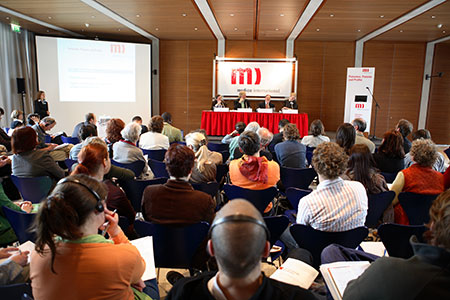
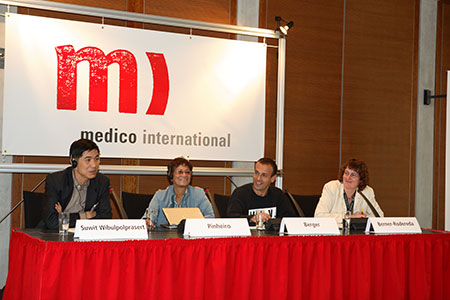
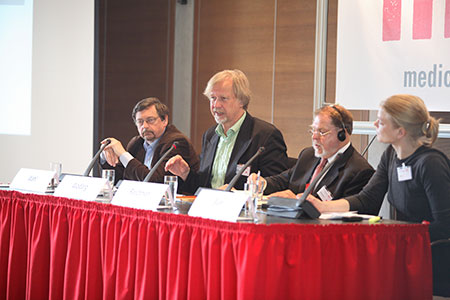
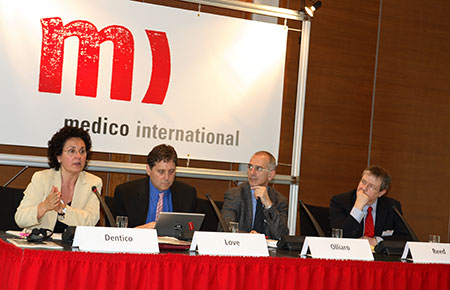
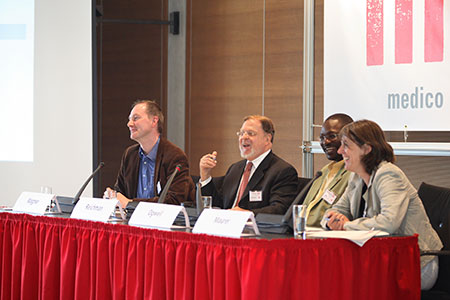
More than 100 persons with varied backgrounds in science, politics, state as well as non-state development co-operation, activist-networks and the pharmaceutical industry followed the invitation to the one-day symposium "Patients, Patents and Profits" by medico international and its partner-organizers BUKO Pharma-Kampagne, Brot für die Welt und Misereor. The venue, the state of Mecklenburg-Vorpommern's representation to the federal government in Berlin not far from the Brandenburg Gate, was deliberately chosen in view of imminent G8-summit in Heiligendamm. On the panels, high-calibre health specialists from the US, Thailand, Kenya, Brazil, South-Africa and other countries delivered substantiated appraisals and analyses of the rising tensions between global health and intellectual property. In the process, the experts moved far beyond a critique of the existing system of research, development and access to medicines necessary for survival. They developed joint proposals for publicly controlled research and alternative incentive- and pricing-systems, which could ensure low-cost drugs and thus access for the poor.
The programme
Opening lecture: Healthcare as a global public good – For a change in the current policy on medicines
The one-day event was inaugurated by medico executive director Thomas Gebauer. Following a short greeting, his lecture opened: "Healthcare as a global public good – For a change in the current policy on medicines" introduced the topic and outlined the course of events.
- Exposé zum Symposium von Thomas Gebauer (PDF, German, 56 KB)
Panel 1: Patients first! The conflict over the access to medicines essential to survival
It followed the first panel moderated by Astrid Berner-Rodoreda (Brot für die Welt). At the outset of the conference, the view fell exemplarily on HIV/AIDS in general and the central struggles which had to be led in the last decades to increase access to effective AIDS-compounds in particular.
Lecture Jonathan Berger: Politics and patents: TAC's campaign for patient rights
First-off, Jonathan Berger, of the south African "Treatment Action Campaign's" "AIDS Law Project", reported on the mobilisation of those affected as well as the international support during the 90s which eventually forced the industry to come around to lower prices.
- Audio (MP3, 19 min. 8,9 MB)
- Presentation (PPS, 419 KB)
Lecture Eloan Pinheiro: Intellectual Property and Human Rights: Myths and Reality on the Access to ARVs medicines
Eloan Pinheiro, former director of the state-run pharmaceutical production, presented the Brazilian way. With the setting-up of an independent state-run generic drug production, the creation of a market-style competitor was achieved which allowed the breaking-up of important pharmaceutical-monopolies. Moreover, the Brazilian government recently decreed a forced licence in order to be able to manufacture an improved but patent-protected AIDS-compound independently at reduced cost.
- Audio (MP3, 17 min., 7,8 MB)
- Presentation (PPS, 2,9 MB)
Lecture Dr. Suwit Wibulpolprasert: Thailand CL: Lessons learned and the Way Forward
Suwit Wibulpolprasert, chief-adviser for health-economics at Thailand's ministry for public health, also briefed on the conflicts over forced licensing regimes. At present, Thailand is in open dispute with multilateral pharmaceutical-groups, as it used the so called TRIPS-flexibilities and issued forced licenses. With this it seeks to permit AIDS-patients in its own country access to highly effective, patent-protected "second-line"-compounds.
- Audio (MP3, 19 min., 9,1 MB)
- Presentation (PPS, 210 KB)
Panel 2: Health and Patents – Access to innovation in the context of intellectual property rights
Moderated by Petra Buhr of "Netzwerk Freies Wissen", the second panel dealt with connection between development and access in the health field in the context of intellectual property.
Lecture Prof. Jerome Reichman: Negative effects – current trends in international patent-policy
First off, Prof. Jerome Reichman, who teaches at the Duke University School of Laws in the US, gave a detailed lecture on the effects of the planned "harmonisation" of international patent protection. From his point of view, this is counterproductive for health and research in the health-sector given countries' diverging stages of development. A harmonisation would cement the predominance of the developed countries. Reichman instead advocated a transfer of knowledge to the south and a joint application of forced licensing regimes to build local production-capacities for medicines.
- Audio (MP3, 25 min., 11,5 MB)
Lecture Dr. Wolfgang Wodarg: Controlling institutions – The significance of public participation
Subsequently, Dr. Wolfgang Wodarg (SPD, MdB), chairman of the sub-committee on health in the parliamentary assembly of the Council of Europe, criticised that patents would no longer be used as a reward, but as weapons in the battle for monopolies. The terrain of research would be mined by patents which in turn would hinder innovation. Furthermore he referred to the fact that via the granting of patents, besides the dispossession of public knowledge, important decisions in health-policy are removed from public control. Decisions of the European patent office, for instance, cannot be reviewed by any parliament. On these grounds, he calls for a compulsory estimation of a patent's consequences and a provision for the retraction of a patent in cases of ample public interest.
- Audio (MP3, German, 15 min., 7 MB)
Lecture Peter Wahl: Development-duties – Global tax systems for the financing of public health
Ways to finance medical research under public responsibility were shown by Peter Wahl of the NGO "Weed". He examined the importance of development-duties and proposed a tax on plane tickets – already practiced by some countries – as well as a global taxation of cross-border financial transactions.
- Audio (MP3, German, 15 min. 7 MB)
Panel 3: Changing the rules – Ideas for the redefinition of intellectual property
After the questions concerning the financing of public medical research had been dealt with, moderator Tim Reed of Health Action International (HAI) Europe directed the attention to concrete alternatives and questions in the definition of research-priorities and incentive-structures beyond patents.
Lecture Dr. Pierro Olliaro: Setting Priorities in Essential Health R&D – A Responsibility of the World Health Organization
What role the WHO could play in an institutionalised framework, which coordinates and ensures the priority-setting for existing health-needs, was investigated by Dr. Pierro Olliaro of the WHO's Special Programme for Research and Training in Tropical Diseases.
- Audio (MP3, 16 min., 7,3 MB)
- Presentation (PPS, 662 KB)
Lecture James Love: Why prizes?
Follwing Dr. Olliaro, James Love of the international consumer-organisation "Knowledge Ecology International" spoke about the different types of "prizes" and proposed a range of alternative push- and pull-mechanisms by which governments can create incentives for the development of urgently needed drugs. Among those is the idea for a "Prize Fund" which rewards innovation not with a licence to charge higher prices but adequate prize money.
- Audio (MP3, 21 min., 9,9 MB )
- Presentation (PPS, 106 KB)
Leture Nicoletta Dentico: DNDi - turning neglect into action
Besides a stimulation of essential medical research via the creation of alternative incentives, research can also be launched through "direct funding". Not least the many
"public private partnerships" (PPP) or "product development partnerships" (PDP), that emerged in the last years, can be understood as an expression of such targeted and in part publicly financed mission oriented research. Nicoletta Dentico, political advisor to the "Drugs for Neglected Diseases Initiative" (DNDi), a worldwide union of research-institutions, reported from the work of such a PPP/PDP. DNDi was recently able to present a new patent-free malaria-drug developed with public funds and in cooperation with Sanofi-Aventis.
- Audio (MP3, 21 min., 9,7 MB)
- Presentation (PPS, 2,5 MB)
Panel 4: Making a Difference: For a change of politics
The fourth and last panel pursued the question of how to turn ideas into reality, in other words strategic considerations which were – moderated by Katja Maurer (medico international) – eventually also discussed with the audience.
Lecture Dr. Ahmed E.O. Ogwell: Working on new Strategies – The IGWG on public Health Innovation and intellectual Property at W.H.O
First, Dr. Ogwell lectured on the "International Working Group's" (IGWG) tasks and chances. He is a member of the IGWG and director for international health-relations in the Kenyan ministry of health. Without him, the IGWG would probably not have been established. In the effort for a political implementation of alternatives, the cross-national working group, established by the WHO in late 2007, could hold a crucial role. Central task of this body is the definition of a new global strategy and a plan of action for the complex "public health, innovation and intellectual property".
- Audio (MP3, 18 min., 8,6 MB)
- Presentation (PPS, 294 KB)
Referat Prof. Jerome Reichman: Treating clinical tests as a public good
That research in the health field as a public goods does not have to be merely a nice idea, but is a concrete possibility, was shown by Jerome Reichman. He developed a proposal for the implementation of publicly funded clinical tests similar to fundamental research. With this it would be guaranteed, so Reichman, that the tests would be aligned with public research needs and not private-sector profit-interests.
- Audio (MP3, 13 min., 6 MB)
Lecture Dr. Christian Wagner: Lobbying for a change- The international "Plattform Innovation und Zugang"
Christian Wagner of the international network "Health Action International", prominent critic of the pharmaceutical industry, and contributor to BUKO Pharma-Kampagne, named the demands that NGOs and organisations in civil society address to the Geneva process around the IGWG. Concerning the assurance of innovation and access to medicines, he emphasized the necessity of public responsibility for medical research and governance of the pharmaceutical market. "Medicines as a public good" is the catchphrase that best summarises the political demands.
- Audio (MP3, German, 15 min., 7,2 MB)
Closing statement
To conclude the event, the organisers called for a change in the global politics of health and presented the joint declaration "For innovation and access to essential medicines!". This Declaration, signed so far by the social-medical aid-organisation medico international, the ecclesiastical relief organisations Brot für die Welt and Misereor as well as the BUKO-Pharma-Kampagne, a critical observer of the pharmaceutical industry, states that many people have to die because pharmaceutical patents act as de-facto monopolies that ensure that medicines necessary for survival are prohibitively expensive or are not developed at all. Necessary medicines should be regarded as public goods and exempted from patent restrictions. The closing statement was spoken by Mute Schimpf (Misereor).
- Closing Statement Audio (MP3, German, 4 min., 1,7 MB)
- Declaration: "For Innovation and Access to Essential Medicines"