Geopolitical shifts that took place between the immediate post-World War period and the onset of the Cold War spawned the birth of Western aid as we know it today. The founding of the United Nations held out the promise of a responsible global community of values, while aid money was intended to help the West pose as the best of all possible worlds, influence the formation of blocs and, above and beyond all this, secure access to raw materials. With the collapse of the previous world order, aid is now also fundamentally up for debate – just like Elon Musk's jingle, "it's time for it to die". The triumph of far-right forces around the world has changed the world even more quickly and radically than we could have ever dreamed or were prepared for – including in the system of aid.
The melting away of the liberal sugar coating
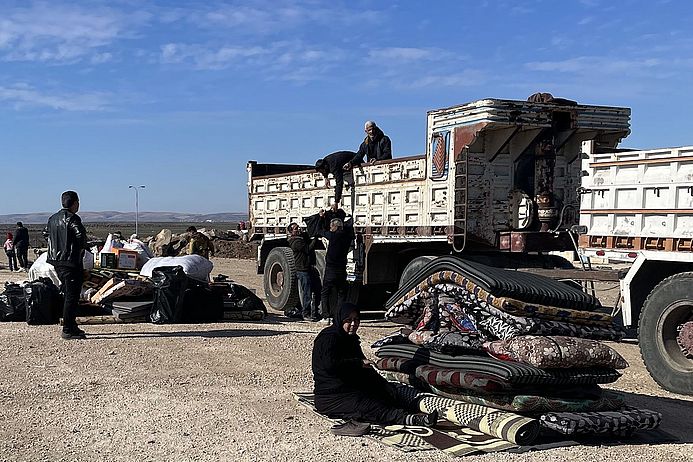
Just a few weeks after Donald Trump took office, the US Agency for International Development was effectively abolished. Since then, 83 per cent of its projects have been discontinued. Almost nothing remains of the American development aid organisation, the largest donor worldwide. The devastating consequences of this decision are already apparent: In the refugee camps financed by USAID, the supply infrastructure could all of a sudden no longer be maintained. Hundreds of thousands of people lack bread and water. Vaccination programmes are flagging and schools have to close. This is particularly dangerous in the case of epidemic and pandemic diseases such as AIDS or polio. Thousands of people worldwide will die completely unnecessarily because they do not receive medication.
This development is shocking, but by no means specific to the U.S.. The erratic Trump is not being offset by a rationally acting, responsible Europe. The UK is considered a forerunner, having merged its Department for International Development with the Foreign Office in 2020 under right-wing Prime Minister Boris Johnson amidst a loud outcry. To this day, it has not been possible to mitigate the consequences. Support for countries such as Pakistan and South Sudan was slashed by more than one-half, for instance, and funding for humanitarian crises and climate protection programmes was significantly curtailed. In countries such as Sierra Leone, which were heavily dependent on British funding, this has massively affected the availability of basic supplies such as drinking water, food and medicine.
The UK is not alone in Europe in this regard. Perhaps not entirely coincidentally, it is the old colonial powers that are displaying a very similar trend. The Netherlands has cut 30 per cent of its development aid budget, redirecting funds to projects that "directly serve Dutch interests". Belgium has chopped its aid by 25 per cent, while France has downsized its budget by more than one-third. Meanwhile, the wheel has been turned even further in the United Kingdom, where foreign aid has been cut by another 40 per cent while defence spending has increased. As concerns mount across Europe about the United States' wavering commitment to European security, Prime Minister Keir Starmer has described the decision as "extremely difficult and painful".
Germany is now also planning to drastically reduce its budget for development cooperation and humanitarian aid, while bolstering its defence budget. The last draft budget of the "traffic light coalition" government already provided for cutting humanitarian aid funding by half. The United Nations agreement, supported by Germany, that each country should allocate 0.7 per cent of its gross domestic product to humanitarian aid and development cooperation has been scrapped. This trend will no doubt intensify with the new federal government under Friedrich Merz.
It only emerged last week that the German Ministry for Economic Cooperation and Development would not suffer the same fate as its British counterpart. According to the current coalition agreement, the ministry will now be allowed to remain. It has been clearly established, however, that from now on the focus is to be on security policy. The coalition agreement succinctly sums it all up: "We need fundamental changes in development policy that better reflect and shape current geopolitical and economic realities. (...) In light of our interests, we will place greater emphasis on the following strategic priorities: economic cooperation and securing access to raw materials, combating the causes of flight, and cooperation in the energy sector."
These values may all be well and good, but not in times of change. Equality, democracy, peace, community and rights-based action, even in an international context – all once part of a common framework of values – have now had their day.
Is this shocking? No.
The framework of international relations was already more than tenuous. This was obvious as far back as the heyday of "value-driven" politics. At that time, wars had to be justified by the defence of liberal values: the U.S. brought democracy to Iraq and, in doing so, liberated Iraqi women from the strictures of patriarchy. In the process, the term "embedded feminism" was coined, meaning that a liberal form of feminism is embedded in the destructive actions of the state in order to cloak them in legitimacy. In the wake of the intervention in Iraq, the public service was also brutally purged while a neoliberal transformation was carried out there by dismantling the social infrastructure. Aid also played a role at that time. medico back then referred to "embedded aid". This meant that aid was almost exclusively used as wrapping paper for security and economic interests, at that time those of the U.S. in Iraq, and later those of Germany in Afghanistan, and had to take back seat to respective security strategies. At that time, humanitarian aid could only be provided in consultation with the warring armies and thus became a political instrument in the war. What we are now experiencing is therefore not fundamentally new, but its momentum has given it a new quality.
The pivotal change is the removal of the pressure to offer justification. Interest-based policies that are very real but left unspoken are no longer under pressure to be concealed or justified by aid, and are instead being expressed openly and loudly. National and chauvinistic state interests are posited as legitimate in themselves and no longer need to be masked. The departure from the notion of a global community based on solidarity is taking place without dishonour.
The liberal sugar coating is melting under the hot sun of the swing to the right and changing times. The people of the "majority world", or the Global South, who were supposed to be protected in its name and receive aid thanks to the generosity of their exploiters, generally did not place all too much stock in it. As Nicholas Mwangi, co-editor of the book "Breaking the Silence on NGOs in Africa" from Kenya, put it during our last visit: "They take nine of my fingers and give me back only the little one, and then they even adorn themselves with it."
From Iraq to Afghanistan to Gaza: criticising and defending aid
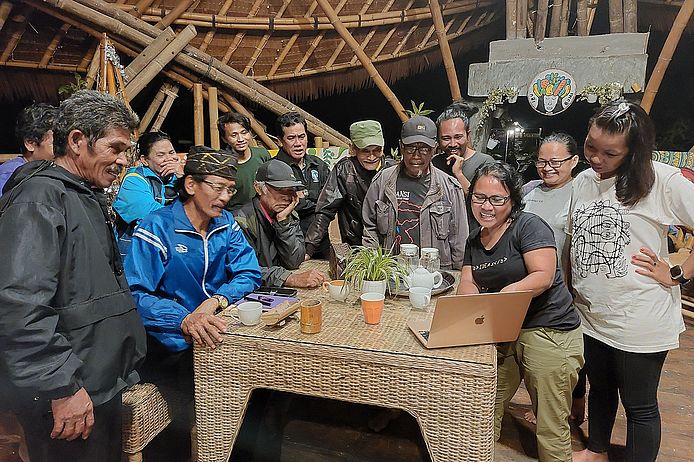
The maxim of "criticising, defending and overcoming aid" has long been a guiding principle for medico's work. But how can the ever-important criticism of aid be continued when its principles are being so questioned in substance? Criticising aid guided by state interests did not stand in contradiction to also using government financial resources to redistribute wealth to the benefit of civil societies in the Global South, which for their part also oppose precisely these arrangements. Even though no civil society is completely independent, the curtailment of German development cooperation funds also reduces medico's latitude within the ambivalent field of aid. Although aid is always a power relationship that must be recognised as such, for a human rights organisation operating in the North, the right to aid is one of the possible avenues to solidarity.
medico therefore defends aid above all where it is denied as a human right, for example in Gaza. Because overcoming aid does not mean abolishing aid and sincere mutual support in times of need. Overcoming aid means working together to overcome the causes of need, not just alleviating suffering itself. Overcoming inequity is a political question of justice. However, global justice requires solidarity, mutual recognition in the struggle for an emancipated and self-determined way of life, which may take on very different forms depending on context and location.
Overcoming aid: the right to life
The various attacks on aid, civil society and movements being witnessed at present are, at the heart of it, all attacks on the notion that all people have an equal right to existence, life, dignity and self-determination. The political practice of medico and our partners is therefore, especially in times of a shift to the right, to oppose the rationale of dehumanisation. For despite all its ambivalences, aid opens up a political arena for civil society and other political actors in the international realm that would otherwise be reserved for states and multilateral organisations. As Cornelia Möhring, spokesperson for global justice for the Left Party, and Andreas Bohne, Africa officer for the Rosa Luxemburg Foundation, explain in an article on cuts in development funding, the aid system is also a projection screen on which global solidarity can be constantly rearticulated and defended. It is a place where a perspective critical of power and capitalism can be conveyed from below. Networks are emerging that can navigate between (transnational) social and political movements as well as the state and multilateral levels. Networks that simultaneously have a local presence, such as the People's Health Movement or Via Campesina. It is this political arena and these levers that need to be defended, not aid in its current form.
These global connections are also reflected in persistent migration movements. Migration continues to challenge the retreat into nationalism and reactionary fantasies of isolationism. Migration movements are a reality that is more than just a spanner in the works of rising authoritarianism. The struggle for freedom of movement that we are waging together with our partner organisations is a struggle for the right to life and, equally, a struggle for democratisation and in opposition to growing nationalism.
Especially in the field of health, which we understand not only as the absence of disease, but as the opportunity to lead a good life that does not make people ill, the principle of aid can be construed as a practice of solidarity. Instead of going along with the wave of nationalisation and patenting efforts, which has been massively propelled by the coronavirus pandemic and primarily serves to protect corporate interests, we and our partners are committed to the idea of health goods as the Commons – common goods – and oppose the patenting of vaccines. This is the only way to address or hopefully even prevent the crises of the present and the future.
We have been doing this for some time with our partners who oppose the privatisation of the health sector and have established health structures that make possible care for all. In Bangladesh, for example, Gonoshasthaya Kendra (GK) is committed to self-organised healthcare. Its 2,500 employees have been organising basic health services for over a million people for decades – often the poorest of the poor, living in slums, textile factories and rural areas. At the same time, GK is part of the global People's Health Movement, where it combats the causes of disease. In times of international cutbacks, their example shows that we must take aid into our own hands and that we can support this in a show of solidarity.
Solidarity is a process
Criticising, defending and overcoming aid is part of this way of practicing solidarity and helps weave visions for the future. We criticise aid wherever, like a wolf in sheep's clothing, it robs people of their dignity, self-determination or independence and pursues private or state interests. Now more than ever, it remains necessary in the face of a global move to the right and under increasingly difficult conditions to overcome the causes of the hardship that makes aid necessary in the first place. We defend the practice of mutual aid as an act of solidarity and a human right, especially when it is denied to people, and see it as a means of achieving solidarity, but not as an end goal.
Solidarity is not a one-way street from North to South. Practicing solidarity means working together and, despite the differences between those involved and differing conditions, creating spaces to shape the world. While our partners defend and keep open political spaces in their contexts and at the transnational level, it is our task to do the same in Germany and at the transnational level. Spaces in which visions can be fashioned and demands articulated, because rightist attacks on these impact not only the present, but also the future. It is about a vision of the future in which a shared world can be conceived from the margins and from the grassroots.
Radwa Khaled-Ibrahim is an officer at the desk for critical emergency aid in medico's public relations department.
Help us defend the right to aid – against indifference and the rationale of utility. Support our partners worldwide with your donation. For a solidarity-based practice from below that does not bow down and guarantees independent and critical aid.