
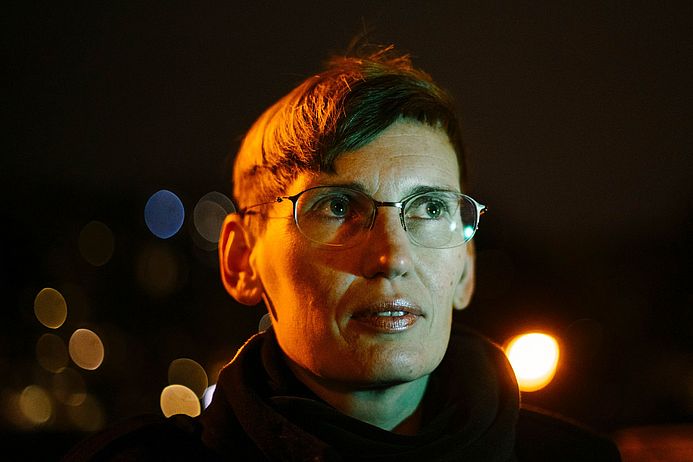
Von Redecker sees the core of new fascism as an unbridled claim to possession, ruthlessly defended no matter what the cost. In an interview with medico in Frankfurt during the book tour for her new book “Dieser Drang nach Härte“(The New Fascism. Entitlement and the Urge to Destroy), she explains what it means when “counterparts are not people, but things” and “enemies are not opponents, but thieves”.
medico: In your new book, you write, ‘Fascism is the “liquidating defence of phantom possession”’. It’s a bit of a head scratcher – you read it and think: ‘Huh?’
Eva von Redecker: The concept of ‘phantom possession’ didn’t just come out of nowhere; it emerged almost ten years ago, when I was trying to understand why various right-wing movements – particularly in the anti-gender discourse – behave as if they were experiencing phantom pain. These people often sound like something has been taken from them, although their relationship with this supposed loss was characterised by violence. It’s not at all a matter of a something precious that you guard carefully, only for it to be stolen; it’s more like someone had taken their punching bag away from them. It’s more about ‘something’ that they want to control and dominate.
This seems antiquated, because we no longer live in a society where people are officially the property of others. That was one of the major achievements of emancipatory struggles. Nevertheless, the entitlement attitude of wanting to have power over others has by no means disappeared. Some people believe they have the right to decide who belongs or who changes how a country looks. It is precisely this imagined power to decide the fate of others that I call ‘phantom possession’.
Yet the modern concept of possession or ownership is very broad: whoever is the owner is, in principle, free to do whatever they want with their property – even to destroy it. How accepted this is can be seen, for instance, with corporations like RWE, which are allowed to destroy entire landscapes.
… and liquidation?
For a long time, I saw authoritarianism as the political promise to defend this ‘phantom possession’ and to restore lost claims to dominance. This comes through, for instance, in border policies, in the building of walls, in the ‘protection of the family’, or in the assertion that feminism goes too far.
Over the last few years, something else has come into play. Defence is no longer confined to drawing borders or securing property. It is increasingly directed against demonised and dehumanised enemies – alleged looters who are to be eliminated, liquidated. At this point, I am talking of fascism.
This triangular relationship between owner, object and abject is abstract. But it is precisely this that explains how flexibly right-wing mobilisation operates. Today it is directed against drag queens, tomorrow against heat pumps. The enemies that are projected are constantly changing, but the underlying structure remains the same. As Adorno once said: ‘The victims can be replaced by other projected enemies.’
With the concept of the ‘possessive character’, you develop a new perspective that goes beyond the explanations offered by classical Critical Theory. What does this term mean?
The Frankfurt School tried to explain why people act against their own interests – for instance, why the working class supports fascist movements even though these ultimately harm them?
Their explanation was that people are susceptible to the pressure to conform - they live in a society that promises equality but constantly produces inequality. These frustrations can be vented in the form of authoritarian and sadistic impulses. That explains a great deal – but not why this aggression is so often directed against specific groups, nor why similar conspiracy narratives repeatedly emerge.
This is where the psychoanalyst Elisabeth Young Bruehl comes in, interpreting violence as a defence mechanism: an unstable psyche attempts to cope with internal pressure by moving it outwards and finding an object for it. Interestingly, these defence mechanisms heavily resemble the logic of property or possession. Who can exercise control, draw boundaries and exclude others? The owner.
How does this connection manifest itself today?
The fundamental idea underpinning bourgeois society is that we are free because we own ourselves. But this relationship with the self is contradictory: how can a person own themselves? Where does this ownership of oneself begin and end?
Particularly those that this idea of sovereignty has historically been ascribed to – for instance middle-class white men – are under pressure to repeatedly re-establish this control. This can then take the form of control over territories, the notion of family, or demarcating boundaries between themselves and other groups.
One example is the debate on migration. When someone perceives a supposed lack of order in public spaces and this leads them to conclude that certain groups are the problem, this is not about describing actual reality. It is about psychological stabilisation: an internal feeling of a loss of control being shifted outwards.
Although I would like to see access to good mental health care for everyone – including right-wing people – I don’t think that therapy can do away with right-wing ideologies. The key question is: what societal circumstances produce these symptoms?
Given current socio-political developments, could one then say that the German Government is currently ‘liquidating’ the social welfare state? Would that already be fascist?
Dismantling the social welfare state is, first of all, a form of neoliberal policy that destroys the future and ruins people’s lives. Yet this is precisely why these policies create conditions in which fascist politics can more easily gain traction.
There are, however, elements of fascist rhetoric in this rolling back of the social welfare state, notably in the sentiment being stoked against those allegedly not working hard enough, and specifically against people who are chronically ill. This is no longer merely about austerity measures; it has such a sadistic exaggeration to it that you get the feeling someone is being punished.
Nevertheless, I would not call every unsocial policy fascist. You can and should oppose such policies too, simply because they are unsocial.
It is something else that is key: the more material security disappears, the more people cling to those illusory arenas in which they still believe they have some control. Phantom possession becomes more attractive when real prospects for the future are lost.
We are now experiencing these fears of loss on multiple levels at the same time: ecologically because of the climate crisis, socially because of the dismantling of public welfare systems. Whilst the number of heatwave deaths is rising, the health system is being slashed. Developments like these produce diffuse fears – and this is exactly where fascist politics can swoop in.
Add to this something historically new: this is the first form of fascism in the age of the Capitalocene. Fossil-fuel-dependent policies, military rearmament and the destruction of the environment are writing deadly violence directly into the planet’s future. Even if political struggles are won, this destruction remains.
You also describe how historical forms of violence are changing and, in some cases, switching sides. Notions like ‘freedom’ are now being redefined by right-wing movements in part. How do you explain these shifts?
If you look at it from the perspective of us all being at the mercy of the unreasonable demand of supposedly owning ourselves and having to assert ourselves in a competitive society, it becomes understandable why such shifts are possible. Even people who have experienced oppression themselves are not automatically free from these patterns after being liberated.
Formal equality without a material foundation can create a profound dilemma: you have gained new freedoms legally speaking, but no real security or control over your own life.
This is evident, for instance, in historical processes of liberation. Following the abolition of slavery in the US or the end of apartheid in South Africa, fundamental property relations were not fully transformed. Whilst some continued to hold actual property, the newly gained freedom of many people remained precarious. This gives rise to the temptation to look for the cause of your own sense of loss in others. The actual property and ownership order disappears from view and is replaced by a phantasm: someone is taking something from me.
You can try to stabilise your own position by excluding or oppressing others. But you can also keep organising and fight for true liberation.
Given the global shift towards authoritarianism, would you say that this psychodynamic applies worldwide?
In recent years, the impetus to speak of ‘fascism’ again has come specifically from colleagues in the Global South. Of course, it makes a difference whether something takes a turn towards Hindu nationalism or a MAGA movement. But it seems to me that now – in a world where liberal democracies prizing individual property and ownership have embarked on a global victory march and neoliberalism has opened the floodgates to these developments – we can see the same dynamics in many places.
I think it makes sense to view fascism as a specific political form that emerges from liberalism. Now that property-based rule has apparently been overcome, property is being reintroduced in a new, propagandistic form. In India, for instance, anti-colonial rhetoric has itself become an important component of the new fascist project. In a sense, this is a ‘postcolonial’ fascism.
In the last few years, we have witnessed the increasing dismantling of the painstakingly constructed – and already fragile – barriers against international violence. This includes certain reliable alliances and conventions under international law. When it comes to the genocide in Gaza, in particular, in Germany in some cases you had the impression that these rules were being set aside almost triumphantly.
So my diagnosis is: liberalism is fracturing in a way that is not emancipatory. It is fracturing to the right. Only if we recognise these patterns can we even begin to envisage the possibility of global resistance and internationalist politics.
At the end of your book, you write: ‘Wealth is boring, and hopefully increasingly difficult to defend. Repair, on the other hand, proves that the future can be reopened even in the midst of these difficult times.’ What role does repair play?
For a long time, the idea behind left-wing thinking on transformation was that there is wealth that was created collectively but is in the wrong hands – we just need to reclaim it. Today, that falls short. We live in a world in which this ideology of growth itself has caused enormous destruction: environmental ruin, toxic waste, but also traumatised people and societies.
That is why repair is needed – not as a return to a past state, but as an emancipatory practice that makes the world habitable again. Without this form of repair – like the one that plays a role in the work of medico’s partners, for instance when it comes to reparations – but beyond that, when it comes to a process of repair – for colonial crimes or damage to the climate – there will be no future. It is not enough simply to fight for a fairer distribution of resources. We also have to work and live together differently. Really, anti-fascism means ‘luxury for all’. It really has to be beautiful wherever people come together.
That is why I also believe that social policy can have an anti-fascist impact: anti-fascism means not pandering to the politics of projecting phantasms and phantom possession, it means changing the social conditions that give rise to them. If people have less fear of loss, part of this dynamic will become weaker. Of course, this will not make all authoritarian or racist patterns disappear, but the foundation of society will change.
The interview was conducted by Julia Manek and Antonie Riek

Eva von Redecker is a philosopher and freelance writer. She explores critical theory, feminism, critiques of capitalism and authoritarianism. Her book Dieser Drang nach Härte. Über den neuen Faschismus (The New Fascism. Entitlement and the Urge to Destroy) was published in February 2026.