Count us out
Breaking free from the logic of war
We live in times of naïve hope. While the news reports daily on the horrors of war, it is at the same time sold to us as a way out of our present-day predicaments. Five years of trench warfare and attrition in Ukraine, but also 25 years of the ‘war on terror’ or the horror of Gaza: the well-documented futility of war appears to do be doing nothing to dent hopes in its healing powers. Instead, the revulsion it causes has been turned into an argument to join in the war effort – while anyone who criticises or questions this logic is regarded as betraying the democratic future, a naïve peace activist, or even a Putinist. How did it come to this?
War, as we are witnessing day in day out, is far more than a battlefield of bodies and machines. It is a way of conceiving the world, and it establishes a horizon of what seems possible and necessary. It is presented to us as the only conceivable way out of a situation beyond our control, in which everything is reduced to security – a security which is to be achieved by military means. We are expected to support rearmament, conscription and military readiness, as only preparedness for war is said to be capable of restoring the security we long for. ‘We’re for peace, but first we must win,’ is how the Berlin rappers K.I.Z. laconically put it. But what if, despite all certainty of victory, victory is not achieved – and the legitimate desire for security merely fuels further escalation?
It is all out of control
Europe is now teetering on the brink. The war, which commenced long ago, has been steadily escalating. Already at this juncture, it has the potential to be the only future imaginable for our continent in the foreseeable future. Its devastation continues unabated in Ukraine and Russia, on our very doorstep, where thousands of people are killed and wounded every day, as if this were both necessary and the most normal thing in the world.
The logic of war is driving the political debate, while diplomacy and international politics are at their lowest ebb in modern history. The ‘Zeitenwende’ (turning point) proclaimed by then-Chancellor Olaf Scholz following Russia’s full-scale invasion of Ukraine implied that an end to this war lay in rearmament. The notion that military strength alone can secure peace was then elevated to the European paradigm – despite its manifest failure in Ukraine – and in the process has been taken to even more extreme lengths and radicalised. The borderline between defence and offence, between attack and counter-attack, is becoming increasingly eroded. At the same time, this requires us, time and again, to push from our minds the reality that the war in Ukraine has already killed hundreds of thousands of people and driven millions from their homes.
The stubborn faith in military force as a means of solving political problems is a dangerous delusion, with far-reaching consequences for the welfare state, peace and democracy alike. We are caught up in a spiral of rearmament, an arms race that would have been unimaginable only a few years ago. Germany is leading the way, planning to spend some EUR 700 billion on that over the next five years. Until recently, the European Commission’s investment drive went by the name ‘ReArm Europe’. The same programme is now being repackaged under the seemingly innocuous title ‘Readiness2030’. We hear talk of self-assertion and a European renaissance, all in an effort to make the war-preparation programme led by Germany more palatable. Because it has to be sold: enthusiasm remains in short supply – including for the ease with which Germany is being touted as a European leading power.
The political culture of post-war Europe, which sought to learn the lessons of two world wars, is being dismantled before our eyes. In the name of peace and democracy, not only is an unprecedented militarisation being pursued at the expense of the welfare state; democratic processes themselves, along with the critical public sphere they depend on, are also coming under attack. ‘Western values’ are invoked and then discarded in the same breath. Yet the authoritarian drift is plain for all to see: since the war in Gaza at the latest, in Germany the case for double standards in the application of international law was openly made while championing a doctrine of “raison d'état” that restricts freedom of expression in a manner reminiscent of an authoritarian regime. Those who follow this path, however, are not defending democracy, and are instead creating the ideal conditions for an authoritarian mindset to flourish. The far right in Europe is consequently being brought into the fold, provided only that it keeps a sufficient distance from the Kremlin and from antisemitism.
…what matters is bringing it to an end
A way out of this dead end of war and rearmament may seem illusory at this juncture. Yet at the same time, it is imperative – indeed, a matter of survival.
What we need is a new internationalist debate. A perspective that rejects nationalist interests, geopolitical bloc-building and a revival of the ‘clash of civilisations’. A new international solidarity with all those – here and elsewhere – who long to see the war end. It is grounded in the common cause shared by Russian, Ukrainian, Palestinian, Israeli, European and other opponents of the war. They are there, even if their voices are quiet or silenced.
What we need, too, is a new European vision. A grand vision capable of challenging the equally grand vision of war. Creating it must be the task – and the work in progress – of all those on whom so much depends in these times, but who seem paralysed, or have even already dug themselves into the trenches, dressing their stance up at times in anti-authoritarian or anti-fascist arguments. Today, rejecting the logic of war is both peace work and defence of democracy.
An international anti-war movement is long overdue. It need not downplay Russia's crimes in order to condemn the war's mindless continuation and escalation in the name of a greater good. Russia invaded Ukraine in February 2022 and set the spiral of escalation in motion. That is a fact. But now, almost five years on, the question is no longer simply who started it. The equally urgent question is this: How do we bring this war – and its grip on our societies, our minds and our lives – to an end?
medico international on September 1
Ukraine
Projects and Partners
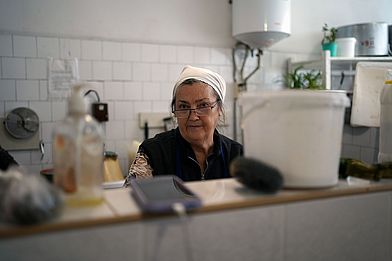
Since February 2022, medico has been supporting groups in Ukraine and neighbouring countries who are resisting the logic of war.