
By Firoozeh Farvardin und Nader Talebi
On the night of January 8th, as millions of Iranians, from all walks of life, backgrounds, and political views, many shouting “death to the dictator,” but also “Long Live the King,” and “Freedom,” and a few locally organized and ready for counterattack, took to the streets, their connection to the world vanished. Suddenly, the internet, cellphones, and even landlines went silent. Despite faint glimmers of connectivity in recent days, Iran has been cut off from communicating with the world ever since.
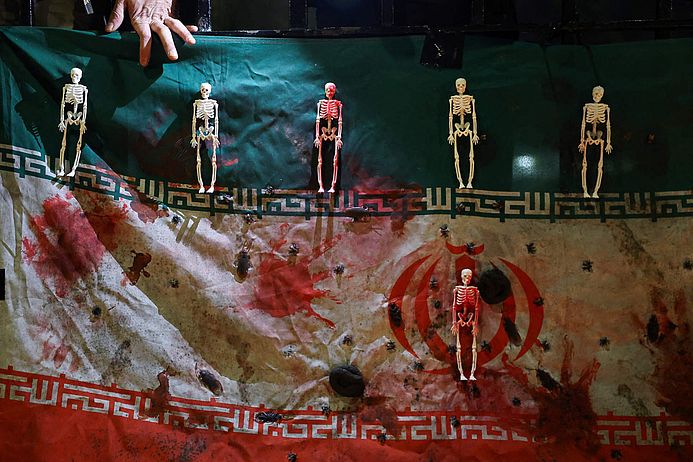
Everyone knows someone who has suffered or died; the dark days of cities without soul, empty and quiet in the midst of the growing death toll. It is an unfolding collective trauma, an unbridgeable gap between a determined mourning people who want to overthrow the Islamic Republic and an oppressive front now full of murderers, those who participated with bloody hands in killing civilians all around Iran. Not that it is the first time that the regime uses visible violence, but the scale of it in terms of sheer number, time density, and geographic spread went beyond expectations. For a structurally discriminatory regime, it proves it kills indiscriminately.
The Nights of Massacre
This round of uprising that led to the nights of massacre started more than two weeks before it. It was a cold, bitter day in the month of Dey (22nd of December) when the word spread: The Bazar was closed. The merchants' strike was a desperate protest against a proposed increase in the income tax and the collapse of the national currency. Since the June War, a limbo has exacerbated the unstoppable inflation that has devastated livelihoods. The high-ranking bazaaris were accustomed to prevailing in government negotiations, but this time was different. Small shopkeepers, lower-level bosses, and everyday customers kicked off the protests, quickly clashing with police. The strike spread like a ripple, capturing national attention with support pouring in from Hamedan, Mashhad, Isfahan, Ahvaz, and Kermanshah. University students soon joined the fray, backing the strikers, and in response, the government shut down the campuses. Though the government initially backed off on the bill and even offered small payments to all Iranian citizens, the unrest didn't stop. Society had hit a breaking point. The focus moved beyond economic grievances to a full-blown opposition to the Islamic Republic. The streets echoed with “death to the dictator" and "death to Khamenei,” mainly, but also “Long Live the King.” Protests erupted in over 200 locations across more than 70 Iranian cities, many in marginalized regions.
On January 7th, the former crown prince called for national protests on the following Thursday and Friday nights (January 8th and 9th). Millions were in the streets across more than 190 cities and many villages in Iran. It was an unprecedented demonstration against the Islamic Republic, the largest single-day street protest in the country's history, that faced the most brutal oppression by the regime. Police fired on demonstrators, resulting in deaths and injuries in cities like Malekshahi and Abdanan in Ilam province.
Two days after the massacre, whispers began to surface. Accounts and videos, gradually leaked through desperate Starlink connections, painted a picture of unbelievable brutality. Even those accustomed to the regime's cruelty were stunned by the shocking reports. Disconnectivity led to the most brutal suppression of dissent in the modern history of Iran, which many now name the largest recorded "massacre against humanity” in 48 hours in the world. Though reliable figures are unavailable from the Iranian government, current estimates of human rights organizations until now confirmed that more than 6,000 people, among them children and the elderly, were killed on the 8th and 9th of January, with estimates reaching over 30,000. Unarmed civilians and protesters faced deliberate targeting from gunshots, snipers, and heavy weaponry. Witnesses spoke of revolutionary guards, police, and militias working together to kill demonstrators and even those who passed the streets mostly young but also from all generations and social classes. Worse still, injured individuals were reportedly denied medical help. Horrifying accounts surfaced of wounded protesters being abducted from hospitals, only for their bodies to be discovered days later, some bearing the tell-tale sign of a final execution shot.
Into dark days ahead
Estimates suggest over 40,000 people were arrested during the recent uprising and subsequent crackdown, a staggering number that includes children, adolescents, and the elderly, alongside suspected organizers and activists who were arrested later. Many face the gravest sentences, including execution, which has already been carried out or is imminent for some detainees following summary courts. A deep fear persists for the fate of many who have vanished into unofficial, secret detention centers rather than registered prisons. This raises the terrifying specter of severe mistreatment, torture, and forced confessions—a threat that looms over everyone in custody, regardless of their location.
Beyond the known detainees, the fate of many protesters and the injured—some forcibly disappeared, others hiding—remains unknown. The survivors of these brutalities, those who witnessed the horrors or lost loved ones, now face severe mental and material distress. The economic fallout is equally devastating: a massacre followed by a national shutdown and an internet blackout. Iran is experiencing its highest inflation in history, with the high possibility of widespread food shortages in the near future. Furthermore, mass unemployment is significant for more than 10 million people whose livelihoods depend on the digital economy and social media; among them, women are the primary earners. This is built up in the context of extensive neoliberalization of the Iranian economy in the past 30 years, coupled with international sanctions.
The regime hopes to establish a reign of terror with the massacre, to prove that it has no boundaries for violence, that it has the command of enough brutal forces that kill without hesitation. Using the war terminology and calling the demonstrators agents of Mossad facilitates such mass killing, and at the same time brings horrifying expectations about the rounds of torture tasked with forcing confessions supporting the regime’s narrative. The expectations are based on previous waves of uprising, where the regime’s TV broadcast courts and confessions after torture to prove that the dissidents were connected to foreign enemies. Despite the regime’s innovation in techniques of torture that developed in the past four decades, prisons have also been a site of resistance. Prisoners organized actions in particular against execution that resonated with similar efforts outside of the prison.
From Anger to Justice or Revenge?
The whole country is engulfed by a profound despair and anger, a collective trauma that might lead to a state of social death. The present circumstances offer no relief, with the future shrouded in uncertainty. The regime shows no willingness to compromise or relinquish its pervasive control. Instead, the terrifying possibilities of foreign intervention, a civil war, and further atrocities, repression, and even mass hunger loom as immediate, suffocating threats.
Yet, while such atrocities can often trigger anger and cycles of revenge, and even amidst this overwhelming despair, a stubborn seed of life remains rooted in the people's collective grief, fuelled by a fierce, unwavering demand for justice and dignity. The Jina revolutionary momentum (2022) was the first time this justice-seeking “we,” who celebrate life against the state's death machine, appeared on the political scene in Iran as a decisive force. This collective self, more visible and represented than ever, finds its most poignant expression not in formal political statements or demands for foreign intervention out of desperation, but in the justice-seeking movement and the insistence on the right to life, collectively performing solemn rituals of mourning. It is at the funerals of the martyrs, in the shared tears, the heart breaking dance of rejecting death and celebrating life, that this new political body is still alive and breathes. A whole country could be united in mourning and in demanding justice, marking a crucial step on the long road to liberation and to a livable life. Although in the midst of an unfolding collective trauma, it is not clear how different parts of society will deal with it, it is clear that the nights of massacre is a turning point in the history of Iran.